Are There Any First Amendment Rights at Work?,

As an employee, you may wonder whether you have any First Amendment rights in the workplace. The answer is not straightforward, as it depends on various factors, including your employment status, the nature of your speech, and the laws in your state.
Does the First Amendment Apply to Me if I Work in the Private Sector?
If you work in the private sector, your employer is not subject to the First Amendment. The First Amendment applies only to government entities, which are prohibited from restricting freedom of speech. Private employers, on the other hand, have more latitude to regulate employee speech, if their policies do not violate other laws, such as anti-discrimination laws.
That being said, California employment law that provide additional protections for private employees who engage in certain types of speech. For example, California Labor Code Section 1102.5 prohibits employers from retaliating against employees who report violations of state or federal law to a government agency.
Similarly, California Business and Professions Code Section 16600 protects employees’ right to engage in lawful competition with their employers.
Do I Have Any Free Speech Rights as A Private Employee?
Although private employees do not have First Amendment protections, they may have free speech rights under other laws. For example, the National Labor Relations Act (NLRA) protects employees’ right to engage in “concerted activities” for mutual aid or protection. This can include discussions of wages, hours, and working conditions. The NLRA applies to most private sector employees, including those who are not unionized.
Additionally, the California Constitution provides broader free speech protections than the First Amendment. California’s Constitution, for example, explicitly recognizes the right to freedom of speech and of the press, and the right to petition the government for redress of grievances.
What is the law in California?
In California, employees have some additional protections. For example, as mentioned above, California Labor Code Section 1102.5 prohibits employers from retaliating against employees who report violations of state or federal law to a government agency. Similarly, California Business and Professions Code Section 16600 protects employees’ right to engage in lawful competition with their employers.
California also has a law that prohibits employers from requiring employees to waive their right to free speech or petition, as a condition of employment. This law, California Labor Code Section 1101, makes it illegal for employers to impose “any rule, regulation, or policy” that prevents employees from engaging in political activity or speaking out on matters of public concern.
What are my rights as a public employee?
If you work for a government entity, such as a federal, state, or local agency, you have some First Amendment protections for your speech. However, the scope of those protections may depend on the nature of your job duties and the content of your speech. For example, if you are a police officer or other public safety official, your speech may be more limited than that of an administrative assistant.
Public employees also have some protections under the Supreme Court’s Pickering test, which balances the employee’s interest in speaking out on a matter of public concern against the employer’s interest in promoting effective and efficient public service.
To pass the Pickering test, the employee’s speech must be a matter of public concern, and the employer’s interest in regulating the speech must be outweighed by the employee’s interest in speaking out.
If you have concerns about your speech rights at work, you may want to consult with an experienced employment law attorney. They can help you understand your rights and determine whether your employer’s policies or actions violate the law.
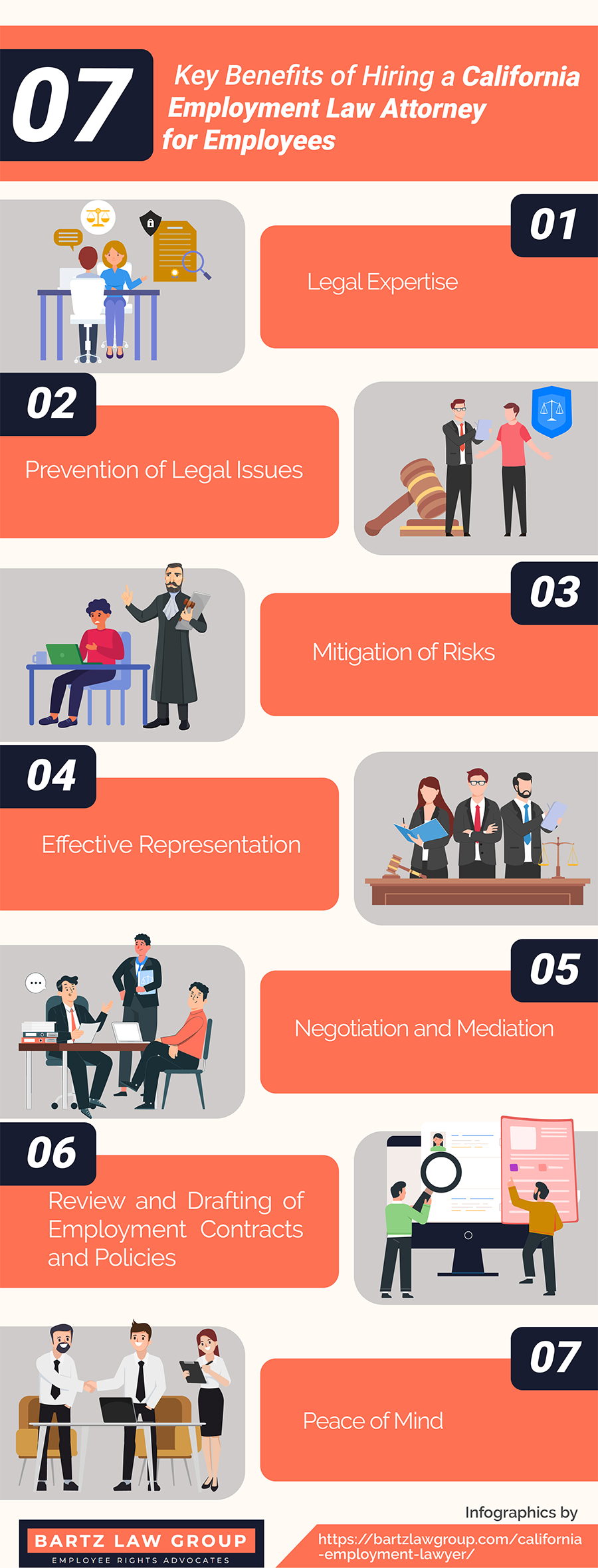
7 Key Benefits of Hiring a California Employment Law Attorney for Employees,

California employment law refers to the set of rules, regulations, and legal precedents that govern the relationship between employers and employees in California. It covers a wide range of issues, including at-will employment, discrimination, wage, and hour laws, employee benefits, workplace health and safety, and privacy rights.
The law sets an essential standard for workplace fairness, helping to prevent discrimination and harassment while promoting safety and health across the state. It helps ensure fair treatment, avoid discrimination and harassment, and promote workplace safety and health, contributing to a healthy and productive economy.
Helping individuals make sense of the state’s complicated laws, a California employment law attorney provides experienced legal guidance to employees. These professionals strive to protect their client’s rights while finding successful solutions for resolving disputes through negotiation or litigation.
One area of potential development in California employment law is the ongoing evolution of workplace privacy rights and the impact of technology on employee privacy.
With millions of people in the state and a constantly changing landscape, employees must stay on top of the law to ensure successful outcomes. Keeping apprised of current insights is paramount for compliance with regulations.
Lunch Breaks For Exempt Employees,

California lunch break law for exempt employees requires employers to provide a 30-minute uninterrupted lunch break to exempt employees who work more than five hours per day. These employees must be relieved of all duties during this break.
If an employer fails to provide the required lunch break, they may be violating California lunch break law for exempt employees. However, exempt employees may voluntarily waive their lunch break if certain conditions are met.
Provisions Of California Lunch Break Law for Exempt Employees
Here are 10 provisions of California lunch break law for exempt employees:
Length of Lunch Break
Exempt employees in California are entitled to a lunch break of at least 30 minutes. This break must be taken no later than the end of the fifth hour of work.
Timing of Lunch Break
The lunch break must be taken before the end of the fifth hour of work. If an employee works for more than 10 hours, they are entitled to a second 30-minute lunch break.
No Working During Lunch
Employers are required to relieve employees of all duties during their lunch break. This means that exempt employees are not allowed to work during their lunch break.
On-duty Meal Period
In certain circumstances, exempt employees may be allowed to have an on-duty meal period. This means that they can eat while still performing their job duties, but only if the employer and employee agree to it in writing.
Revoking A Meal Period
Employers are not allowed to revoke a lunch break once it has been granted to an exempt employee. Employees must be allowed to take their full lunch break.
Penalty Pay
If an employer fails to provide a meal break to an exempt employee, they must pay the employee one additional hour of pay at their regular rate of pay.
Voluntary Waiver
Exempt employees may voluntarily waive their lunch break if they work no more than six hours a day. This waiver must be in writing and can be revoked at any time.
Restrictions on Waiver
Exempt employees who work more than six hours a day cannot waive their lunch break. Even if an employee signs a waiver, they are still entitled to a lunch break.
Recordkeeping
Employers must keep accurate records of all meal breaks provided to exempt employees. The records must be kept for at least three years.
Retroactive Payments
If an employer fails to provide a meal break to an exempt employee, they must pay the employee one additional hour of pay at their regular rate of pay for each day that the employee did not receive a meal break. The payments must be made retroactively, even if the employee did not complain at the time.
California law provides several provisions to protect the lunch break rights of exempt employees. Employers must comply with these provisions to avoid penalties and legal action. Both employers and employees need to understand these provisions and their rights to avoid any misunderstandings or disputes.
Whistleblowing FAQs,

Whistleblowing is when an employee discloses information about illegal or unethical practices within their organization. Many California whistleblower cases have played a key role in reducing workplace misconduct or illegalities.
Whistleblowers often face retaliation, but there are laws to protect them from this. California whistleblower cases have set a precedent for protecting employees who report illegal activity and have resulted in significant settlements for those who have suffered retaliation.
Common Whistleblowing FAQs
Whistleblowing is the act of revealing illegal or unethical activities within an organization. This can be a difficult decision to make for many people, as it can potentially have serious consequences for their careers and personal lives. To help individuals navigate this complex issue, here are 10 frequently asked questions about whistleblowing.
What Protections Do Whistleblowers Have?
In many countries, whistleblowers are legally protected against retaliation from their employers. This can include being fired, demoted, or harassed. Protections vary depending on the country, but some examples include the US Whistleblower Protection Act and the EU Whistleblower Directive.
How Should I Report Misconduct Within My Organization?
It is important to follow the proper channels when reporting misconduct within an organization. This may include reporting to a supervisor, an ethics hotline, or a government agency. The appropriate channel will depend on the nature and severity of the misconduct.
Can I Remain Anonymous When Reporting Misconduct?
Can I Remain Anonymous When Reporting Misconduct?
Can I Be Fired for Whistleblowing?
In many countries, it is illegal for employers to retaliate against whistleblowers. However, this does not mean that it never happens. If you believe you have been retaliated against for whistleblowing, it is important to seek legal advice.
What Are the Potential Consequences Of Whistleblowing?
Whistleblowers may face a range of consequences, including retaliation from their employer, social isolation, and damage to their career prospects.
What Should I Do if I Witness Misconduct but Am Unsure If I Should Blow The Whistle?
It can be difficult to know what to do when you witness misconduct within an organization. It may be helpful to seek advice from a trusted advisor or legal professional. It is important to carefully consider the potential risks and benefits before deciding.
What Kind of Misconduct Can Be Reported Through Whistleblowing?
Whistleblowing can be used to report a wide range of misconduct, including fraud, safety violations, discrimination, and harassment. The appropriate channel for reporting will depend on the nature and severity of the misconduct.
How Can I Protect Myself from Retaliation?
There are several steps you can take to protect yourself from retaliation, including documenting any instances of retaliation, seeking legal advice, and engaging in self-care. It is also important to understand your legal rights and the protections available to whistleblowers.
Understanding the legal protections available to whistleblowers is crucial. It helps whistleblowers make informed decisions on when and how to blow the whistle.
California Salary Laws – What Workers Need to Know,

As an employee in California, you should know the state’s laws and regulations regarding salary and compensation. These laws are designed to protect you and ensure you are paid fairly for your time and labor. By understanding these laws, you can advocate for your rights as an employee and ensure that you are being compensated fairly and equitably for your work.
California salary laws
California wage and hour laws apply to all employees who work in the state. Employees are classified as either exempt or non-exempt. Exempt employees are not entitled to overtime pay and must meet certain criteria. Non-exempt employees are entitled to overtime pay and must be paid at least the minimum wage for all hours worked.
California’s pay transparency laws require employers to provide job applicants with a pay scale for the position they are applying for upon request and prohibit employers from relying on an applicant’s salary history as a factor in determining their compensation. These laws are designed to promote pay equity and prevent employers from perpetuating pay disparities based on past compensation.
Minimum salary for non-exempt employees in California
As of January 1, 2023, the minimum wage in California is $15 per hour for employers with 26 or more employees and $14 per hour for employers with 25 or fewer employees. Some cities and counties in California may have higher minimum wage rates.
If an employer has violated California salaried employee laws, you can file a claim with the California Labor Commissioner’s Office to recover any unpaid wages, overtime pay, or other compensation that is owed.
Minimum salary for “white-collar” workers?
White-collar workers who are exempt from overtime pay must earn a monthly salary equivalent to at least two times the state minimum wage for full-time employment. This means that white-collar workers must earn a monthly salary of at least $5,040 for full-time employment with employers who have 26 or more employees, and $4,666.67 for employers with 25 or fewer employees.
Some white-collar employees may be entitled to overtime pay despite being classified as exempt if they do not meet the salary threshold or duty tests required under California law. Some cities and counties in California may have higher minimum wage rates that may impact the minimum salary threshold for white-collar workers.
Can my employer pay men and women different salaries?
Under California law, employers are prohibited from paying men and women differently for doing substantially similar work. This is known as the California Equal Pay Act and applies to all employers in the state. California’s Fair Pay Act also requires that employers provide equal pay for “substantially similar work” across gender, race, and ethnicity. California also has pay transparency laws under Senate Bill 1162, which require employers to provide employees with a pay scale for their position upon reasonable request.
Can my employer reduce my salary?
In California, an employer cannot reduce an employee’s salary without providing notice and obtaining the employee’s consent. However, there are some exceptions to this rule. For example, if the reduction is part of an overall reduction in the workforce or the employee’s duties or responsibilities have changed significantly.
For exempt employees, there are certain requirements that must be met in order to reduce their salary. If an employer reduces an exempt employee’s salary below the threshold amount, then the employee may no longer be exempt and may be entitled to overtime pay.
Suing an employer for violating California salary laws
You could sue your employer for California salary laws violation. You can file a claim with the California Labor Commissioner’s Office or file a lawsuit in court. If you decide to file a lawsuit, you may be able to recover unpaid wages, and interest. There are strict deadlines for filing claims and lawsuits related to wage and hour violations in California. It’s a good idea to consult with an employment law attorney to understand your rights and options under California law.
California has some of the most employee-friendly salary laws in the United States. These laws provide important protections for workers and help ensure that employees are paid fairly for their work. If an employer has violated California’s wage and hour laws, consult with an employment law attorney to understand your rights and options.
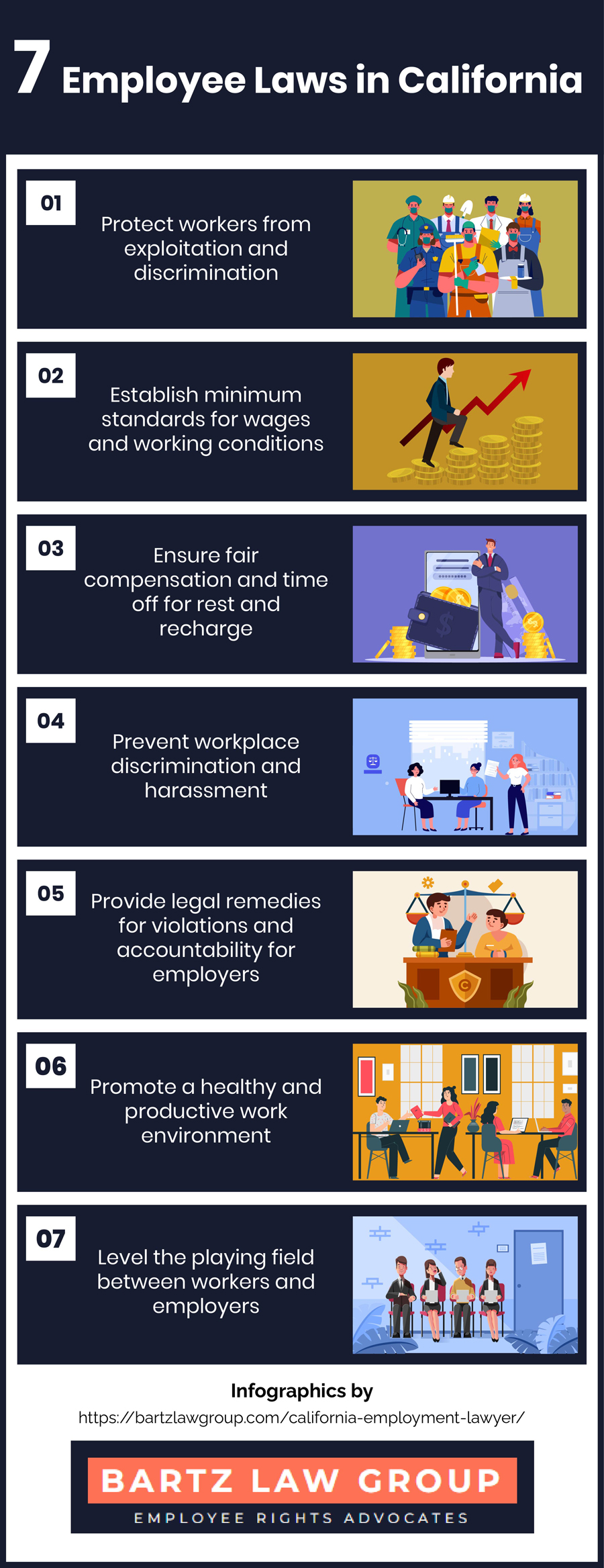
7 Employee Laws in California,

Employee laws in California are crucial for ensuring that workers are protected from various forms of exploitation and discrimination in the workplace. These laws establish minimum standards for wages, working conditions, and employee rights that employers must uphold throughout the state. Some key employee laws in California include the minimum wage, overtime pay, meal, and rest breaks, anti-discrimination and harassment laws, workers’ compensation, and family and medical leave.
These laws are important for several reasons. First, they help ensure workers are fairly compensated for their time and effort and have adequate time off to rest and recharge. This can lead to increased job satisfaction and improved mental and physical health for employees.
Additionally, these laws help to prevent discrimination and harassment in the workplace, which can have significant negative effects on employees’ well-being and productivity.
Furthermore, employee laws in California help to level the playing field between workers and employers, especially when workers may have little bargaining power or leverage. These laws help ensure employers are held accountable for violations and that employees can seek legal remedies if necessary.
Overall, employee laws in California play a vital role in promoting fairness, equity, and safety in the workplace. They help protect workers from abuse and exploitation and promote a healthy and productive work environment.
California Wage and Hour Laws,
As an employee in California, you have certain rights regarding your pay and work schedule. The state has specific wage and hour laws to ensure you are fairly compensated. Understanding these laws is essential for protecting your rights and ensuring you receive the pay and benefits you deserve. This article will discuss California wage and hour laws in detail.
The minimum wage in California
The minimum wage in California is currently $15.50 per hour for employers. This rate applies to all industries except certain exempt employees, such as outside salespersons and apprentices.
It’s important to note that some cities and counties in California have set their minimum wage rates, which may be higher than the state’s minimum wage. For example, the minimum wage in San Francisco is currently $16.32 per hour.
The minimum wage is different in California for tipped employees
Under the federal Fair Labor Standards Act (FLSA), employers must pay tipped employees a cash wage of at least $2.13 per hour as long as the employee’s tips bring their total earnings up to the federal minimum wage of $7.25 per hour. If employees’ tips do not bring their total earnings up to the federal minimum wage, the employer must make the difference.
In California, however, tipped employees are entitled to the same minimum wage as other employees. This means that employers in California are required to pay tipped employees the state’s minimum wage in addition to any tips they may receive.
When am I entitled to earn overtime in California?
In California, you can earn overtime pay if you work more than eight hours a day or 40 hours a week. Overtime pay is calculated at one and a half times your regular pay rate. If you work more than 12 hours a day, you are entitled to double time, which is calculated at twice your regular pay rate.
Some exceptions exist to these rules, such as for certain exempt employees, including executives, professionals, and administrative employees. However, these exemptions have specific criteria that must be met to qualify.
Entitled to a lunch or rest break in California
Under California law, you are entitled to a 30-minute uninterrupted meal break if you work more than five hours daily. If you work more than 10 hours daily, you are entitled to a second 30-minute meal break. These meal breaks must be taken before the end of the fifth hour and the end of the tenth hour of work.
In addition, you are entitled to a 10-minute paid rest break for every four hours worked. These breaks must be provided as close to the middle of the work period as possible.
California Wage and Hour Laws
California labor laws for hourly employees are designed to protect hourly employees from unfair pay practices. These laws cover various issues, including minimum wage, overtime pay, meal and rest breaks, and other working conditions. If you believe your employer is violating California labor laws, you can file a complaint with the California Labor Commissioner’s Office.
Where do wage and hour laws in California come from?
California wage and hour laws come from various sources, including federal and state laws, court decisions, and administrative regulations. The federal Fair Labor Standards Act (FLSA) sets most employees’ minimum wage and overtime pay requirements.
In addition to federal laws, California has its own wage and hour laws that provide additional employee protections. The California Labor Code and the Industrial Welfare Commission (IWC) Wage Orders set the state’s minimum wage requirements, overtime rules, and rest and meal break requirements.
California wage and hour laws are in place to ensure that employees are treated fairly and compensated appropriately for their work. As an employee, you must be aware of your rights and speak up if you believe your employer is violating these laws. Understanding your rights and advocating for yourself can help create a fair and just workplace.
What “At-Will” Employment Means Under California Law,

When you work in California, you may hear the term “at-will” employment. This means an employer can terminate an employee’s employment at any time without giving any notice or reason. As an at-will employee, you also have the right to leave your job anytime for any reason. However, there are certain limitations to at-will employment in California that both employers and employees should be aware of.
Employers Don’t Need a Good Reason to Fire At-Will Employees
As an at-will employee in California, your employer does not need a good reason to terminate your employment. For example, if your employer decides they no longer need your services, they can terminate your employment without giving you a specific reason. However, there are limitations to this rule. Employers cannot terminate an employee’s employment for an unlawful reason.
Employers Can’t Fire Employees for Unlawful Reasons
Under California employment law, the termination of at-will employment cannot be based on certain unlawful reasons. These reasons include discrimination, retaliation, and violations of public policy. Discrimination can occur based on race, gender, age, religion, national origin, and disability.
Retaliation is when an employer terminates an employee’s employment because the employee engaged in a protected activity, such as reporting discrimination or harassment. Termination of employment violates public policy if it is against the law or public policy.
Anti-Discrimination Laws
The California Fair Employment and Housing Act prohibits discrimination based on protected classes like race, gender, and disability. If an employer terminates an employee’s employment based on one of these protected classes, it violates California employment law. Employees who believe they have been discriminated against can file a complaint with the Department of Fair Employment and Housing.
Laws Protecting Union Activity
The National Labor Relations Act protects employees’ rights to organize and join unions. Employers cannot terminate an employee’s employment because they engaged in union activities or attempted to form a union. Employers cannot threaten employees with termination or retaliation for engaging in union activities.
Laws Protecting Whistleblowers from Retaliation
California law also protects employees who report illegal activity, health and safety violations, or other illegal conduct by their employer. Employers cannot terminate an employee’s employment for whistleblowing or participating in an investigation or hearing related to whistleblowing.
Protected Leaves of Absence
Under California law, several types of leaves are protected, meaning an employer cannot terminate an employee’s employment for taking such leave. These leaves include the Family and Medical Leave Act (FMLA), the California Family Rights Act (CFRA), and pregnancy disability leave. Employees who take one of these leaves must be allowed to return to their job when the leave is over.
Public Policy Limitations on At-Will Employment
In addition to contractual limitations on at-will employment, California law prohibits employers from terminating employees for reasons that violate public policy. For example, an employer cannot terminate an employee for:
- Refusing to engage in illegal activity
- Taking time off to serve on a jury
- Reporting a workplace safety violation
- Engaging in political activities outside of work
A somewhat complicated legal analysis is required to determine whether a reason for termination is prohibited by public policy. In general, several elements are considered, including:
- The existence of a clear public policy: The policy must be well-established and well-defined.
- The employee’s compliance with the public policy: The employee must have acted following the public policy.
- The employer’s motivation: The employer must have terminated the employee because of the employee’s compliance with public policy.
- The harm caused to the employee: The employee must have suffered harm due to the termination.
If you believe your employer has violated your rights or terminated you for an unlawful reason, take action to protect yourself. Review your employment contract, document any unlawful actions, file a complaint with the appropriate government agency and consult an employment lawyer. By taking proactive steps, you can protect your rights as an employee and ensure you are treated fairly and lawfully in the workplace.
The Benefits of Working with the Best Whistleblower Attorney in Corporate Fraud Cases,

Corporate fraud can be a serious problem that negatively affects businesses, employees, and consumers. That said, whistleblowers play a crucial role in uncovering such fraud by reporting it to the relevant authorities. In California, whistleblowers are legally protected under California Labor Code section 1102.5, which prohibits retaliation against employees who report violations of state or federal law.
However, despite these legal protections, coming forward as a whistleblower can still be a challenging and daunting process. That’s why having legal representation as a whistleblower is essential. The benefits of working with the best whistleblower attorney in corporate fraud cases are:
Lawyers have Knowledge and Expertise
Whistleblower attorneys have specialized knowledge and experience in handling corporate fraud cases. They can provide valuable guidance and advice on how to file your claims. Also, they have extensive knowledge of state and federal laws that protect whistleblowers, and they understand the complexities of whistleblower cases.
Whistleblower attorneys use their experience to help you build a strong case. Your lawyer can conduct thorough investigations, gather evidence, and advise whistleblowers on how to present their claims effectively. With their help, you also understand their rights and options, as well as any potential risks or challenges involved in their case.
Whistleblower Attorneys Have Protection and Confidentiality
Many whistleblowers fear retaliation. Whistleblower attorneys can help protect whistleblowers from retaliation by their employers or other parties involved in the fraud. They can do this by advising whistleblowers on how to protect their job status and their physical and emotional safety.
The attorney-client privilege is also an essential element of legal representation for whistleblowers. This privilege ensures that any confidential information you share with the lawyer is protected and kept strictly confidential. This can help whistleblowers feel more secure and comfortable sharing sensitive information that may be vital to their case.
Whistleblower Lawyer Guidance through the Process
Whistleblowing can be complicated and confusing, and the assistance of an experienced attorney can make a significant difference. Your attorney can help you understand the process, from filing a complaint to taking legal action against their employer or the parties involved in the fraud.
They can also provide guidance on preparing and presenting a complaint and advise you on the specific steps involved in filing your claim. You also receive legal representation throughout the entire process, including any investigations or litigation that may occur.
Attorneys negotiate for fair Settlements
Working with a lawyer can help you achieve fair settlements for your claims. Whistleblower attorneys have extensive experience negotiating with employers, corporations, and government agencies and can advise you on the ideal course of action to achieve the best possible outcome.
You also learn the potential risks and benefits of any settlement offers, as well as the implications of accepting or rejecting these offers. Ultimately, the goal of a whistleblower attorney is to help you achieve justice for the harm you have suffered.
If you’re a whistleblower in California, consider working with a whistleblower attorney. The benefits of legal representation are clear, from protection and confidentiality to guidance through the process and fair settlements. Don’t let fear or uncertainty hold you back from coming forward with your claim.
How to sue your boss for wage violations,

Federal and state employment laws require employers in California to pay employees a minimum wage of $ 7.25 and $15.50 per hour respectively. The according to Fair Labor Standards Act (FLSA) also requires employers to provide overtime pay for hours worked more than 40 in a work week or 8 hours in a workday. Employers who underpay their workers are responsible for twofold damages.
Damages you could receive for FLSA violations
Under the FLSA, employees can recover damages for unpaid minimum wage and overtime pay, as well as liquidated damages and attorney’s fees. Liquidated damages are an additional amount of money you could receive if your employer acted in bad faith.
Who is covered by the FLSA?
The FLSA covers most private and public sector employees, including those who work in factories, offices, and retail stores. Also, the FLSA applies to companies with $500,000 or more and those engaging in interstate commerce. Other employers are those using phone lines, the internet, or mail. However, some exceptions exist, such as independent contractors and certain agricultural workers.
How do I know if my employer violated the FLSA?
There are several ways that an employer may violate the FLSA, including failing to pay minimum wage and not compensating employees for overtime hours.
Minimum Wage
Under the FLSA, most employees must be paid at least the federal minimum wage of $7.25 per hour. If your employer is paying you less than the minimum wage, they are in violation of the FLSA. Note that as of 2023, the California government states that the minimum wage is $15.50 per hour.
Overtime
The FLSA requires your employer to pay you time-and-a-half if you work more than:
- 40 hours per workweek
- Eight hours per workday
- Six days per workweek
If your employer is not paying you overtime, they may be in violation of employee rights and California labor law.
What You Should Do If Your Employer is Not Paying Correctly
If you believe that your employer is not paying you correctly, several steps that you could take are:
- Ensuring that all deductions are correct.
- Ensuring overtime is compensated.
- Ensuring the pay rate is correct.
- Ensuring that your work hours are correct.
- Ensuring your paycheck is correct.
Suing your employer for not paying minimum wage or paying overtime
If your employer has violated the Fair Labor Standards Act, you want to file a lawsuit. Working with an experienced labor attorney who can help you understand your legal options and build a strong case is advisable.
Wage violations can occur when an employer does not pay their employees the correct wages, such as minimum wage or overtime pay. You could take legal action and recover damages for unpaid minimum wage and overtime pay. Working with an experienced attorney is advisable to ensure that your rights are protected and that you receive the compensation you deserve.