What You Need to Know About Severance Pay in California,

Severance pay is a topic many California employees may be familiar with but need to understand fully. In this article, you learn the legal meaning of severance pay in California and the various nuances of this type of compensation. From the mandatory requirements to the tax implications, this write-up covers everything you need to know about severance pay in California.
The legal meaning of severance pay in California
Severance pay, also known as termination pay, is a financial benefit offered to employees terminated or laid off from their jobs. The package should be proportional to the employee’s tenure and the role and can be negotiated based on a mutual agreement.
The purpose of severance pay is to provide a cushion for employees who have lost their jobs and may struggle to find new employment. Reasonable severance pay may include continued health insurance coverage, outplacement services, and other benefits that can ease the transition to a new job.
Is severance pay mandatory in California?
Severance pay is not mandatory in California. Unlike many other states, California has no laws requiring employers to provide severance pay to their employees. However, some employers may offer severance pay to soften the blow of termination and minimize the risk of legal disputes.
Can I collect unemployment benefits if I get severance pay in California?
Under employment law in California, you could collect unemployment benefits if you receive severance pay in California. However, the unemployment benefits you are eligible to receive may be reduced by the severance pay you receive.
If the severance pay is less than the maximum unemployment benefit, you will receive the difference between the two. It is important to note that severance pay is not a substitute for unemployment benefits, and employees can still qualify for unemployment benefits regardless of severance pay.
Calculating severance pay in California
As mentioned earlier, there is no legal requirement for severance pay in California. As a result, the calculation of severance pay can vary widely from one employer to the next. Some employers may base the amount of severance pay on the employee’s length of service, while others may use a formula based on the employee’s salary or position. Some employers may also offer a lump-sum payment, while others may provide payments over some time.
The meaning of a severance agreement
A severance agreement is a legally binding contract between an employer and an employee that outlines the terms of the severance pay. The agreement may include details such as the amount of severance pay, the duration of the payments, and any other benefits to which the employee is entitled. It also may contain some terms related to non-disclosure, non-competition, or settlement of disputes.
Federal laws on severance payments or severance agreements
There are no federal laws that specifically govern severance payments or severance agreements. However, specific federal laws may apply to severance pay in certain circumstances. For example, the Age Discrimination in Employment Act (ADEA) prohibits discrimination against employees 40 years of age or older, and the Americans with Disabilities Act (ADA) prohibits discrimination against employees with disabilities.
How is severance pay taxed?
Severance pay is considered taxable and subject to federal and state income taxes. Employers are required to withhold taxes from severance pay just as they do with regular wages, and the employee will be required to report the severance pay as income on their tax return.
Some severance agreements may offer options for the payment to be structured differently, such as lump sum or rolling payments. The tax implication of these options should be evaluated before deciding.
Severance pay can provide a valuable financial cushion for terminated or laid-off employees. Although severance pay is not mandatory in California, many employers may offer it to minimize the risk of legal disputes and help ease the transition to a new job. Understanding the legal meaning of severance pay in California, the rules around collecting unemployment, the meaning of a reasonable severance package, and tax implications can help employees navigate the process and make informed decisions about their severance pay. It’s always recommended to seek legal advice to assist with the process and ensure that the severance package offered is fair and reasonable.
Misclassification of Non-Exempt Employees as Exempt in California,

Misclassifying employees as exempt or non-exempt is a common problem in California, particularly regarding overtime pay. California labor laws dictate certain employee rights, including overtime pay, that can be affected by the classification of an employee as exempt or non-exempt. This article teaches the difference between exempt and nonexempt employees and what to do if you believe your employer has misclassified you.
What if my employer misclassified me as an exempt employee in California?
If your employer misclassifies you as an exempt employee, you may miss out on necessary rights and benefits to which you would be entitled as a non-exempt employee. This includes the right to overtime pay and meal and rest breaks. The misclassification may also prevent you from receiving other benefits, such as unemployment insurance and workers’ compensation.
The difference between exempt and non-exempt
In California, there is a difference between exempt and nonexempt employees. The classification of an employee as exempt or non-exempt is based on their job duties, the amount they are paid, and the way they are paid.
Exempt Employees
Under California labor laws on exempt employees, exempt employees are not entitled to overtime pay or meal and rest breaks. They are salaried employees performing executive, administrative, or professional duties. Exempt employees are usually paid a set salary and are not eligible for overtime pay, regardless of the number of hours worked.
Non-Exempt Employees
Non-exempt employees in California are entitled to overtime pay and meal and rest breaks. They are typically hourly employees who perform manual labor or other non-executive, non-administrative, or non-professional duties.
Non-exempt employees are usually paid an hourly wage and are eligible for overtime pay based on the number of hours worked.
Why would my employer intentionally misclassify me as exempt?
Employers may intentionally misclassify employees as exempt to avoid paying overtime or providing other benefits. This can be a cost-saving measure for the employer, but it can be detrimental to the employee. Employers may also misclassify employees due to a lack of understanding of California labor laws or by mistake.
Signs that an employee is misclassified as exempt
There are several signs that an employee may be misclassified as exempt. Some signs include:
- Being paid a salary but performing non-exempt job duties.
- Being denied overtime pay, even though you have worked more than 8 hours per day or 40 hours per week.
- Being denied meal and rest breaks, even though you have worked more than 5 hours daily.
- Being expected to work through lunch or breaks without receiving additional pay.
Can I be fired for complaining about misclassification?
It is illegal for an employer to retaliate against an employee for complaining about misclassification. You may have a claim for wrongful termination if you believe you have been fired, demoted, or subjected to other forms of retaliation for complaining about misclassification.
Can I sue my employer for misclassification?
If you believe you have been misclassified as an exempt employee in California, you have the right to sue your employer. You may be able to recover unpaid overtime and other damages, including interest and penalties. An experienced employment attorney can help you understand your rights and guide you through suing your employer.
Misclassifying employees as exempt or non-exempt can significantly impact the rights and benefits to which an employee is entitled. If you believe you have been misclassified as an exempt employee in California, it is crucial to understand your rights and take action. Consulting with an experienced employment attorney can help you understand your rights and navigate the legal process. It’s always recommended to take legal action in case of any illegal treatment to ensure fair compensation and prevent future violations of labor laws.
California Whistleblower-Friendly Anti-Retaliation Provisions,

As a whistleblower in California, it’s essential to understand the state’s anti-retaliation provisions that protect you from retaliatory actions. This blog will provide an overview of these provisions and how they apply to whistleblowers in California. The article also discusses how to report retaliation and offers tips for protecting yourself as a whistleblower in the state.
A whistleblower is an individual who reports misconduct or illegal activity within an organization. In California, several laws protect whistleblowers from retaliation for speaking out. These laws encourage individuals to report wrongdoings and hold organizations accountable for their actions.
California’s anti-retaliation provisions for whistleblowers
Under California law, it is illegal for an employer to retaliate against an employee for engaging in protected activity. Protected activity includes making a complaint or report of misconduct or illegal activity, participating in an investigation or proceeding related to such a complaint or report, or refusing to participate.
Some examples of retaliatory actions that are prohibited in California include:
- Terminating or suspending an employee
- Demoting or transferring an employee
- Reducing an employee’s pay or hours
- Intimidating or harassing an employee
If you are a whistleblower in California and you have experienced retaliation, you may be able to seek remedies such as reinstatement, back pay, and damages. According to Assembly Bill 1947, signed into law in 2020, California whistleblowers may also be entitled to California whistleblower lawyer fees and costs if they prevail in a retaliation claim.
How to report retaliation as a whistleblower in California
If you are experiencing retaliation as a whistleblower in California, there are a few steps you can take to report it and seek help. First, document the retaliatory actions that have been taken against you. This may include keeping a record of any verbal or written communication related to the retaliation and witness statements.
Next, consider speaking with an experienced whistleblower attorney to discuss your options. Consider filing a complaint with the appropriate agency. In California, this may be the Department of Fair Employment and Housing (DFEH) or the Occupational Safety and Health Administration (OSHA).
It’s important to note that there are time limits for reporting retaliation as a whistleblower in California. According to Assembly Bill 1947, you must file a complaint with the DFEH within one year of the retaliatory action, and you must file a complaint with OSHA within 30 days of the retaliatory action.
Tips for protecting yourself as a whistleblower in California
Here are a few tips for minimizing the risk of retaliation and protecting yourself as a whistleblower in California:
- Be aware of the laws that protect whistleblowers in California and your rights as a whistleblower.
- Keep accurate records of any misconduct or illegal activity that you witness, as well as any retaliatory actions that are taken against you.
- Consider speaking with an experienced whistleblower attorney before making a report or participating in an investigation.
- Know your options for seeking legal representation and remedies if you experience retaliation as a whistleblower in California.
California has strong anti-retaliation provisions in place to protect whistleblowers from retaliatory actions. Understanding these provisions and taking steps to protect yourself can help ensure that your rights as a whistleblower are upheld. If you are a whistleblower in California and have experienced retaliation, consider seeking legal representation and exploring your options for seeking remedies.
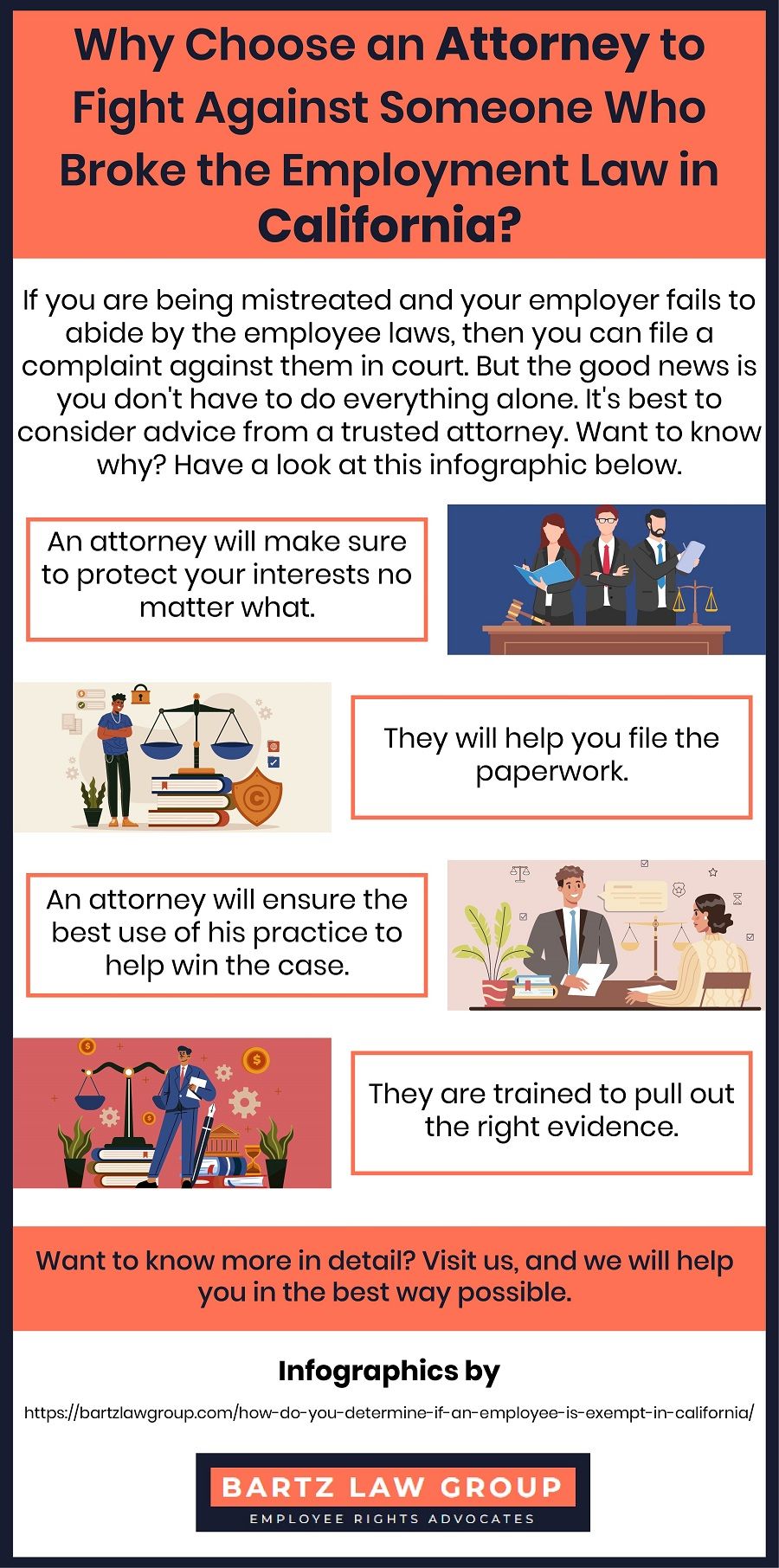
Why Choose an Attorney to Fight Against Someone Who Broke the Employment Law in California?,
California laws are of two types, one is for exempt employees, and the other is for non-exempt employees. Employees have a great scope of protection under California salaried employee laws. Those employees who are exempt do not get the same right to salary and legal protections.
Actions to take if harassed at the workplace in California,

Employees who experience workplace harassment have a right to have their complaints investigated, according to California’s anti-harassment law, the Fair Employment and Housing Act, or FEHA. Employees who are the victims of harassment can sue their employers or the harassers for monetary losses.
The measures that a harassed employee can take to enforce their rights under the Fair Employment and Housing Act of California are:
Inform the Employer of the Harassment
If you have been the victim of workplace harassment, inform your employer as soon as possible. By doing so, you can help prevent further harassment from occurring and also protect yourself from potential liability.
When informing your employer of the harassment, provide as much detail as possible. This includes describing the behavior that made you feel harassed, the responsible party, and when the conduct occurred. If you have any documentation or witnesses who could corroborate your story, mention that.
After you have reported the harassment to your employer, keeping a record of what happened is important. This includes keeping a journal of events, saving relevant emails or documents, and speaking with witnesses. These records will be helpful if you need further action, such as filing a complaint with the Equal Employment Opportunity Commission or filing a lawsuit.
File a Harassment Complaint with the California Department of Fair Employment and Housing
You can file a complaint with the California Department of Fair Employment and Housing (DFEH) if your employer does not take prerequisite action after informing them of your harassment incident. The DFEH is responsible for investigating claims of discrimination and harassment in the workplace.
The investigator will contact you to discuss your complaint and may also contact witnesses or other individuals with knowledge of the incident. The investigator will then prepare a report which a supervisor will review.
If the DFEH finds sufficient evidence to support your claim, they will take action against the individual or employer who committed the harassment. This may include ordering them to stop the harassing behavior, providing monetary compensation for damages, or requiring them to take corrective measures such as participating in training on anti-discrimination or anti-harassment policies.
File a Harassment Lawsuit Against Your Harasser or Your Employer
There are a few things to consider before deciding whether or not to pursue legal action, including:
- What type of harassment are you dealing with? If it’s sexual harassment, you may have a claim under Title VII of the Civil Rights Act of 1964. If the harassment is based on another protected characteristic like race, religion, or national origin, you may have a claim under state or local anti-discrimination laws.
- Who is the harasser? Is it your supervisor, a co-worker, or someone else in the organization? If it’s your supervisor, you may have a claim against the employer for failing to prevent or stop the harassment. If it’s a co-worker, you may still have a claim against the employer if the company knew about the harassment and failed to take appropriate action.
- What evidence do you have? Did you keep copies of any offensive emails or texts? Do you have witnesses who can corroborate your story? The more evidence you have, the stronger your case will be.
- Whether or not you’re willing to go through with a trial. A trial can be long and stressful, and there’s no guarantee you’ll win. If you decide to pursue legal action, speak with employment lawyers in southern California to help you navigate the process.
You can take many actions if you’re harassed at work in Southern California. Consider consulting with an attorney to see if you have any legal recourse. Whatever you do, do not suffer in silence. Make sure you stand up for yourself and get the help you need.
FAQs
What should I do first if I am sexually harassed at work in California?
Tell your employer right away. Write down what happened, when it happened, and who was there.
Can I sue my employer if I was sexually harassed at work in California?
Yes, you can. Under California’s FEHA law, victims can sue employers or harassers for money damages.
What evidence helps if I was sexually harassed at work?
Save emails, texts, or photos. Witness names help a lot, too. More proof means a stronger case.
Can my boss fire me for reporting sexual harassment at work in California?
No. Firing you for reporting is illegal retaliation. That gives you grounds for a second separate lawsuit.
The California “WARN Act” – Protections for Employees After Mass Layoffs,

If you are an employee in California, you are familiar with the state’s Worker Adjustment and Retraining Notification (WARN) act. This legislation was enacted to provide certain protections for employees affected by mass layoffs or plant closures. Here is what you need to know about the California WARN Act:
What is the California WARN Act?
The California WARN Act is a state law that requires employers with 75 or more employees to provide 60 days’ notice to employees, their representatives, and certain government agencies before the following:
- A mass layoff: This is considered the layoff of at least 50 employees within 30 days.
- Relocation: This refers to the transferring of all or almost all of a business operation to a new site at a distance of at least 100 miles.
- Termination: This is the full or partial cessation of a company’s activities.
What Protections does the California WARN Act provide for Employees?
The California WARN Act provides several protections for employees affected by mass layoffs or plant closures. According to California employee law, employers should provide advance notice of the layoff, which gives employees time to prepare for the loss of their jobs and to seek other employment opportunities. In addition, the WARN act requires employers to provide certain information to affected employees, such as the reason for the layoff and the number of employees who will be affected.
When is an Employer Required to Give Notice Under the California WARN Act?
An employer must give notice under the WARN Act, Labor Code 1400 et seq. if it plans a mass layoff, relocation, or termination of employment. The notice must be given at least 60 days before the effective date of the layoff, relocation, or termination.
What are the Consequences for Employers Who Violate the California WARN Act?
An employer who violates the California WARN Act could be liable to affected employees for damages. Employees may be entitled to back pay and benefits for the period between the date the notice should have been given and the date the layoff, relocation, or termination of employment occurred. In addition, the employer may be required to pay a civil penalty of up to $500 per employee for each day of violation.
How Can Employees Seek Remedies If Their Employer Violates the California WARN Act?
If you believe that your employer has violated the California WARN Act, you are liable to seek remedies by filing a lawsuit in court. You should consult an experienced employment law attorney to discuss your options and determine the best action for your situation.
The California WARN Act is an essential piece of legislation that protects employees who may be affected by mass layoffs or plant closures. If you are an employee in California and your employer is planning a mass layoff, relocation, or termination of employment, it is crucial to understand your rights under the Act and to seek legal assistance if you believe your employer has violated the Act.
Employment Rights Every Person Should Know in California,
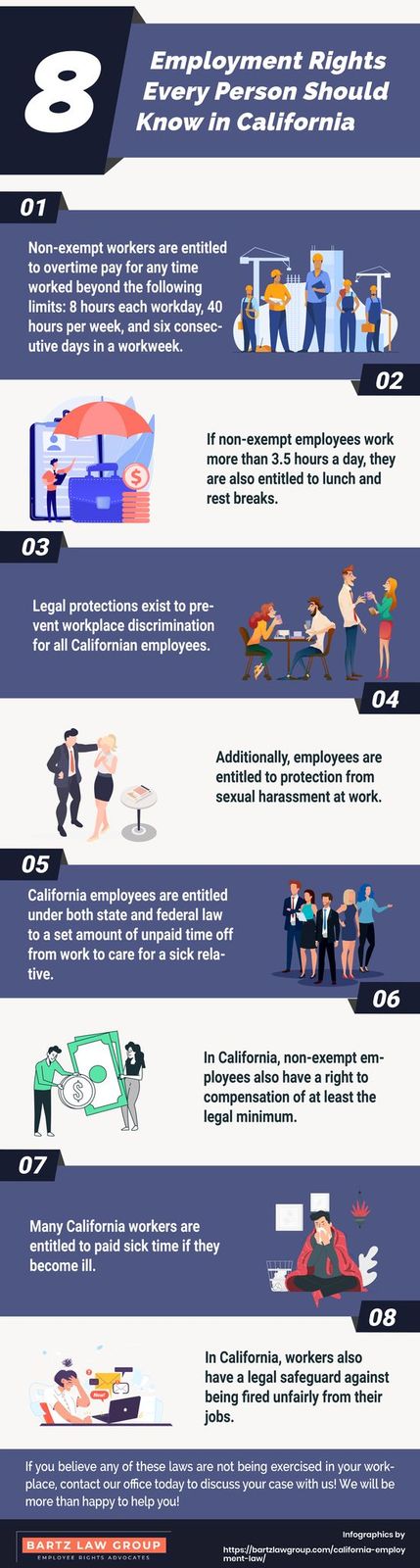
If you are a working employee in California, you should always know the various employment laws. This list of laws will help protect yourself from the wrongdoings in your organization if any. If anything comes up and you are well aware of the employee rights of California labor, then we are sure it will be easier for you to press charges. Want to know those laws right away? Let’s have a look at this infographic below!
What Does it Mean to Be “Exempt” under California Labor Laws?,

The California Labor Code governs California labor law. Exempt employees are typically not entitled to the federal minimum wage and overtime provisions of the Fair Labor Standards Act. Still, they must be paid at least twice the regular rate for all hours worked in a workweek in addition to receiving time-and-half pay for any hours worked over twelve.
What is an Exempt Employee?
An exempt employee is an employee who is not entitled to overtime pay or other protections under California labor laws. Exempt employees are typically high-level executives or professionals, such as doctors or lawyers.
Exempt status is determined by an employee’s job duties and salary, not by their position within the company. For example, a salaried managerial employee may be exempt if their job duties meet the requirements of an executive exemption. Still, an hourly worker who performs the same job duties would not be exempt.
What Are the Requirements to Be Exempt?
An employee must meet certain requirements to be exempt from California labor laws. These requirements include:
- Being paid a salary of at least $58,240 per year ($1,120 per week) in a company with 25 or fewer employees. In companies with 26 or more employees, the employee must earn 62, 400 per year ($1,200 per week);
- Performing executive, administrative, or professional duties as defined by the Fair Labor Standards Act (FLSA); and
- Being employed full-time – defined as working at least 40 hours per week.
If an employee does not meet all of these requirements, they may still be exempt if paid on a commission basis or perform highly compensated work as defined by the FLSA.
How Do I Know if I Am an Exempt Employee or Not?
You first need to look at your job duties and see if they match up with any of the exempt categories under California labor laws. If your job duties don’t fall into one of these categories, then you are likely non-exempt.
California has four main categories of California labor laws for exempt employees, including executive, administrative, professional, and outside sales. To qualify as exempt under one of these categories, employees must meet specific requirements regarding their job duties and be paid on a salary basis.
Let’s take a closer look at each category:
- Executive Employees: To qualify as an exempt executive employee, you must manage the enterprise or a department or subdivision of the enterprise; regularly direct the work of two or more other full-time employees or their equivalent; have the authority to hire or fire other employees, and customarily and regularly exercise discretion and independent judgment.
- Administrative Employees: To qualify as an exempt administrative employee, you must perform office or non-manual work directly related to management policies or general business operations of your employer or your employer’s customers; perform substantial supervisory or control work over the work of other employees; have authority to make decisions that impact the business operation of your employer in a significant way; and exercise discretion and independent judgment regularly.
- Professional Employees: To qualify as exempt, you must perform work requiring advanced knowledge in a field of science or learning that is custom.
In California, employees exempt from overtime pay must meet certain criteria. If you are unsure if you are exempt from overtime pay, talk to your employer or an experienced employment lawyer.
Exempt vs. non-exempt employees in California,

California labor laws for salaried employees protect non-exempt workers. However, there are two types of workers in California; exempt and non-exempt.
The difference between the two types of workers is based on various factors, such as duties, pay structures, etc. While non-exempt employees are protected under California labor laws for salaried employees, exempt employees are protected under federal law.
How to Determine Employment Status
Your employment status is dependent on several factors, including
- Income;
- Job title; and
- Duties.
The law sets the guidelines for what constitutes exempt and nonexempt employees.
1. Salary limits
Employees who receive an annual salary of $58,240 or less are considered non-exempt. The salary limit for companies with 25 or fewer employees is $54,080 a year for nonexempt employees.
The aforementioned limit or rule should be a guideline and not an absolute. In other words, employers and labor commissioners use this rule to determine employment status.
2. Job titles
Some jobs are more likely to earn exempt status than others under California law. Management and executive positions are more likely to be exempt than lower-rated jobs. Although exempt jobs are many common jobs that are considered exempt, including people working as executives, administrators, managers, and various professionals.
Executive titles
Executives hold the most senior positions in most companies. Small and medium-sized companies have few top-level employees who’d be considered exempt, but large companies, especially corporations, can have hundreds of executives. Common exempt executives can include:
- Chief Executive Officers;
- Chief Financial Officers;
- Chief Operations Officers;
- Departmental Vice President;
- Directors;
- Board Members, and
- Regional/National/International Director or Managers.
Administrative Titles
Administrative roles can vary by the company and the job description. However, most administrative jobs fall under the exempt category in California. Common exempt administrative jobs in California include:
- Executive Secretaries;
- Personal Assistants;
- Senior Assistants;
- Administrators, and
- Assistants/Directors/Managers.
Professional Titles
Professional employees are typically considered exempt. Many professional jobs are in the same group as executive and senior management jobs for purposes of labor relations. Common professional jobs can include:
- Lawyers;
- Doctors;
- Consultant;
- IT Managers, Database Managers, and Webmasters; and
- Senior Accountants, among others.
Although professional jobs are usually considered exempt, you shouldn’t always trust the job title alone to determine your employment status. Consult with a labor law attorney to be sure about your employment status.
3. Terms of Engagement
Most jobs are classified as exempt, including:
- Freelance workers;
- Independent contractors;
- External sales professionals, and
- Some IT and tech workers
The above-listed jobs are considered exempt, but there can be exceptions. That said, you should check with a labor lawyer instead of assuming that all is well.
Rights of Exempt and Nonexempt Employees in California
Exempt and nonexempt jobs attract certain rights and responsibilities in California. Those rights and obligations can impact your job in addition to determining your employment status or classification. California labor commissioners consider the benefits, perks, and tangible benefits that an employee enjoys determining classification or employment status.
In California, employees are either exempt or non-exempt. A skilled labor attorney can help you determine your employment status.
Employee Rights in California,

Terminated employees have certain rights, such as the right to terminal benefits, continuing health insurance coverage, and more. Per employee rights in California labor law, terminated workers may also be entitled to unemployment compensation benefits and all perks mentioned thereon.
While employee rights under the California labor law protect workers against unfair labor practices, they can take extra measures to protect themselves after a job loss.
Employee Rights After a Job Termination
You cannot protect yourself if you don’t understand your rights and terms of engagement.
At-Will Employment
Most employment contracts are “at will.” Under these arrangements, an employer can terminate an employee at any time and for any reason, as long as the termination doesn’t violate the law or the terms of your agreement. However, a wrongful termination can arise if:
- The employment relationship is implied. Implied contracts arise if continuous employment is guaranteed, the employer violated termination guidelines or the employment duration.
- An employee is terminated contrary to public policy. For instance, firing someone for participating in jury duty, serving in the military, complaining about malpractice, or refusing to commit an illegality.
Anti-discrimination
Federal and state laws prohibit discrimination against existing and prospective employees based on the protected characteristics of employment, including race, skin color, age, national origin, disability, religious and political affiliations, and more.
Retaliation
Employers cannot fire their employees for speaking out about illegality or reporting unlawful activity. Common malpractices in the workplace can include sexual harassment, discrimination, or violating the Occupational Safety and Health Act (OSHA).
Employee Rights After a Job Termination
Final Paycheck
You are entitled to receive your final paycheck after job termination. The laws of issuing employees their last paycheck can vary by jurisdiction.
California employees must get their final paycheck immediately if they were fired or if they gave a 72-hour notice. Employees who fail to give notice should receive their compensation after 72 hours. A contractual agreement between an employee and employer can invalidate the laws governing the issuance of a final paycheck.
Severance Pay
A severance agreement allows terminated employees to receive their final pay. Additionally, the employer is released from all liabilities and future claims.
Severance pay can include:
- Lump sum payment;
- Health insurance;
- Continuing payments for several years, and
- The services of an outplacement program.
Employers are not obligated to offer severance pay to terminated employees as per the Fair Labor Standards Act (FLSA).
The terms of your employment agreement determine your eligibility for severance pay.
Health Coverage
Terminated employees are entitled to health insurance coverage for a limited duration. This right is protected under the Consolidated Omnibus Budget Reconciliation Act (COBRA) of 1986. Businesses with 20 or more employees must give their employees the option to continue participating in the health insurance plan provided by their former employers. However, former employees must pay for their coverage.
Unemployment Compensation
Terminated employees can receive unemployment compensation in some cases. This perk helps qualified employees to cater to their needs as they transition to their new jobs or as they search for employment.
In California, terminated employees have certain rights. Consult an employment lawyer today to discover your rights.