Whistleblower Retaliation Damages and Compensation,

Depending on the specifics and legal foundation of your whistleblower protection lawsuit in California, the damages you can demand from your employer as restitution for whistleblower retaliation could change.
The best course of action could be to speak with a lawyer. A knowledgeable California whistleblower lawyer can evaluate your claim, determine potential damages, and walk you through the legal process. Your legal strategy is influenced by the quality of your claim, supporting documentation, and the compensation you deserve.
Damages You Can Recover for Whistleblowing
In California, Labor Code 1102.5 protects employees who report state or federal law violations by their employers. If you are retaliated against for whistleblowing, you may be able to recover damages, including:
- Lost Wages: You may recover lost wages if you can show that you were retaliated against and that the retaliation resulted in you losing your job or being demoted.
- Emotional Distress: You may recover damages for emotional distress if you show that the retaliation was severe and caused significant emotional suffering.
- Punitive Damages: You may recover punitive damages if you show that the employer acted with malice or reckless indifference to retaliate against you. Punitive damages are intended to punish the employer and deter future misconduct.
Proving Whistleblower Retaliation
To prove whistleblower retaliation under Labor Codes 98.6 and 6310, you will need to show that:
- You reported an unlawful activity or working condition to your employer.
- You suffered an adverse employment action, for example, termination, demotion, or harassment.
- The adverse action was taken in retaliation for your report.
If you can establish these elements, you may be entitled to compensation for lost wages, benefits, and punitive damages. An experienced attorney can help you gather the evidence you need to prove your case.
Filing a Whistleblower Retaliation Claim Under Whistleblower Protection Act
If you have been retaliated against for whistleblowing, you may be entitled to damages under the Whistleblower Protection Act (WPA). To seek damages, you must file a complaint with the Office of Special Counsel (OSC) within 30 days of the retaliatory action.
The OSC will investigate your complaint, and if they find evidence of retaliation, they will file a formal complaint on your behalf with the Merit Systems Protection Board (MSPB). The MSPB is an independent agency that adjudicates disputes involving federal employees.
Suppose the MSPB finds that you were retaliated against. In that case, they can order your employer to take corrective actions, including reinstating you to your former position, giving you back pay, and paying your attorney’s fees.
You may also be able to file a private lawsuit against your employer for damages. However, this option is only available if the MSPB does not take action on your behalf or if your employer does not comply with the MSPB’s order.
If you believe you have been retaliated against for whistleblowing, it is important to act quickly to protect your rights.
Whistleblower retaliation is a serious issue and one that deserves to be taken seriously by those who have experienced it. If you or someone you know has been the victim of whistleblower retaliation, don’t hesitate to reach out to an experienced attorney who can help you get fair compensation.
6 Rights You Probably Didn’t Know You Have As An Employee,

California labor law has many employee rights that allow workers to work in safe and privileged work environments. Unfortunately, employees do not know some of those rights and laws because they’re never included in employee handbooks.
All employee rights in California labor law have one purpose, to protect employees from all manner of exploitation and abuse by employers and managers. In other words, California employees should understand their rights to know when they’re being exploited, manipulated, or violated.
Top 6 Rights for Employees in California
Minimum Wage Pay
Employers are required to pay their workers a minimum wage for at least 3 hours of their work shifts, regardless of the working hours. For instance, an employee is entitled to $10.20 x 3 hours = $30.60 if they go home earlier than usual because there is no work.
Employees have the right to turn down any work that may risk their life or health and that of their co-workers, per the Occupational Safety and Health Administration Laws. The law prohibits employers from paying their workers lower than the minimum wage, even if an employee consents to such an arrangement. If a person works for more than 8 hours in a workday, they should receive overtime pay.
Salary Deduction for Workplace Mistakes
Most people are conditioned to believe that their salaries should be deducted for minor mistakes at the workplace, such as broken items or shortages of cash (for cashiers). The truth is that your salary shouldn’t be deducted because of a small and innocent mistake, especially if another person can be blamed for the same mistake.
Paid Annual Leave or Annual Vacation
Did you know you’re entitled to an annual vacation if you work for the same organization for 12 consecutive months? This should be the case as per California’s Labor Law.
Workplace Safety
Employers are responsible for the safety of employees in the workplace, meaning they should ensure appropriate safety equipment is provided to employees and they are trained on how to use such equipment when necessary to avoid workplace injuries. Safety equipment can include:
- Gloves;
- Goggles;
- Mask to prevent breathing hazards; and
- Safety boots and clothes, and more.
Discrimination-Free Work Environments
The workplace should be free from any form of discrimination and harassment. Employees must be treated fairly and justly, regardless of their race, origin, gender, nationality, social & marital status, and sexual orientation.
Employees with Special Needs
California Labor Law requires employers to make the necessary adjustments at the workplace to accommodate employees with special needs, such as victims of mental illnesses or physical disabilities.
Federal Regulations Ensuring Employee Rights
The federal regulations that protect the rights of employees include:
- Title VII of the Non-discrimination Act prohibits discrimination in the hiring process based on the protected characteristics of employment.
- Americans with Disabilities Act (ADA)
- Age Discrimination in Employment Act
- Fair Labor Standards Act:
- Family and Medical Leave Act:
California employees should know that the law protects them. Additionally, you can file legal action against your employer for exploitation and discrimination.
The Importance of Fair Employment and Treatment of Workers,

How you treat your employees can significantly influence the success of your business, besides being a critical aspect of corporate social responsibility. Employers have a legal obligation to ensure prospective employees are hired based on their skills and qualifications, per California’s employment laws.
Discrimination should never have a place during the recruitment of employees. Besides a non-discriminative recruitment process, employers should always treat their employees fairly and equally. Employee laws in California highlight the importance of fair employment and treatment of workers, as we’ll expound in this article.
Benefits of Fair Employment and Treatment of Workers
The benefits of fair employment and treatment of employees go beyond the moral duty of implementing reasonable labor practices. We’ve outlined the reasons why businesses should prioritize honest engagement.
1. Fair Employment and Treatment Boosts Brand Image
Business stakeholders, such as customers, clients, investors, and workers, must make critical decisions about their support businesses. Failing to treat your employees equally and failing to implement fair employment practices means that the image of your brand will likely be dented or damaged. A negative brand image can result in:
- Reduced sales;
- Reduced leads;
- Reduced business contracts;
- Lack of willing investors; and
- Difficulty in recruiting business partners.
Implementing fair employment practices and treating your workers fairly can boost your brand’s image and position your business strategically for support.
2. Employee Satisfaction and Reduced Employee Turnover
Your employees will always feel dissatisfied if your recruitment process is unfair or if you treat employees unfairly and unequally. Employee dissatisfaction can negatively impact productivity, cause reduced profitability, and increase turnover.
Treating your workers fairly and considerately translates to hiring job candidates based on their skills, qualifications, and abilities, ultimately improving employee satisfaction and retention. In simple terms, your business benefits if your workforce is satisfied and this will reduce employee migration and save training costs.
3. Zero Tolerance for Corruption
Implementing fair employment and treatment shows that your organization does not tolerate corruption. Employees should be hired on merit and not because of personal relationships or other unfair practices, such as bribery.
Job applicants shouldn’t be awarded low wages or subjected to unfavorable working conditions. Having a strict recruitment policy and ensuring your workers are fairly treated deters corrupt practices, such as bribery, within an organization.
4. Legislation Compliance
The law requires employers to treat their workers fairly. Implementing fair practices in your organization shows that your business is legally compliant with anti-bribery laws and fair employment laws. Fair employment laws ensure the hiring process is without bias, facilitating the hiring of skilled, qualified, and experienced employees. Hiring top talent increases productivity and profitability as new skills and ideas come on board.
It’s important to treat your employees equally and fairly. An organization where workers are treated fairly enjoys increased productivity and profitability.
Whistleblower Protection Act FAQs,

The Whistleblower Program encourages whistleblowers to come forward to expose wrongdoings through monetary incentives. That said, it’s important to understand the whistleblower Protection Act.
In simple terms, the whistleblower program encourages people to report wrongdoings and malpractices in the workplace without being unfairly targeted. A California whistleblower lawyer can help you understand the whistleblower Protection Act
The Whistleblower Protection Act Explained
The Whistleblower Protection Act protects the rights of whistleblowers, as aforementioned. This Act requires both government and private employees to expose any activities that violate the law, including:
- Mismanagement of resources in the workplace;
- Gross waste of finances;
- Abuse of authority, and
- Activities that pose a risk to public health and safety
The Whistleblower Protection Act also prohibits retaliation, such as demotion, dismissal, and pay cuts, for exposing malpractices and providing legal remedies for whistleblower retaliation. In simple terms, this Act allows whistleblowers to make disclosures confidentially.
Who is protected under the WPA?
The Act mainly protects government employees, excluding employees working for intelligence organs like the FBI. The WPA focuses on protecting unclassified employees.
Protections of federal employees whom the WPA does not cover
The rights of whistleblowers working for intelligence communities are enshrined in the Intelligence Community Whistleblower Protection Act of 1998, the Intelligence Authorization Act for Fiscal Year 201, and the Presidential Directive 19.
FBI whistleblowers have been protected against retaliation by the U.S. Code § 2303 and the FBI Whistleblower Protection Enhancement Act of 2016. One thing to note is that intelligence community and FBI whistleblower protections are as strong as those provided by other federal whistleblowers, with fewer retaliation remedies.
Who Investigates Complaints Under the WPA
The Office of the Special Counsel (OSC) is mandated to investigate federal whistleblower complaints, which are typically filed confidentially. The primary duty of the OSC is to “safeguard whistleblowers who work for the federal government from prohibited malpractices in the workplace, such as reprisal and retaliation for whistleblowing.
Adjudication of Complaints under the WPA
The Merit System Protection Board (MSPB), established in 1978, is tasked with adjudicating whistleblower complaints. The primary mission of this board is to promote a good workplace environment free of prohibited workplace malpractices.
Remedies of Whistleblower Protection Retaliation
The following are some of the remedies for whistleblower retaliation:
Job Restoration
Under this remedy, you can get your job back if you were dismissed because of exposing workplace wrongdoings and illegal activities.
Reversal of Adverse Actions
Negative consequences of whistleblowing (retaliation), such as demotion, dismissal, and pay cuts, can be reversed.
Damages
According to the OIG, “reasonable and foreseeable consequential damages” can be awarded to a whistleblower if it’s established that their employers acted with malice. The damages can include medical expenses, legal fees, or other costs that a whistleblower incurred due to retaliation.
The rights of whistleblowers are protected under the Whistleblower Protection Act. In general, the protection act prevents whistleblowers from being punished for exposing wrongdoings or malpractices of an organization.
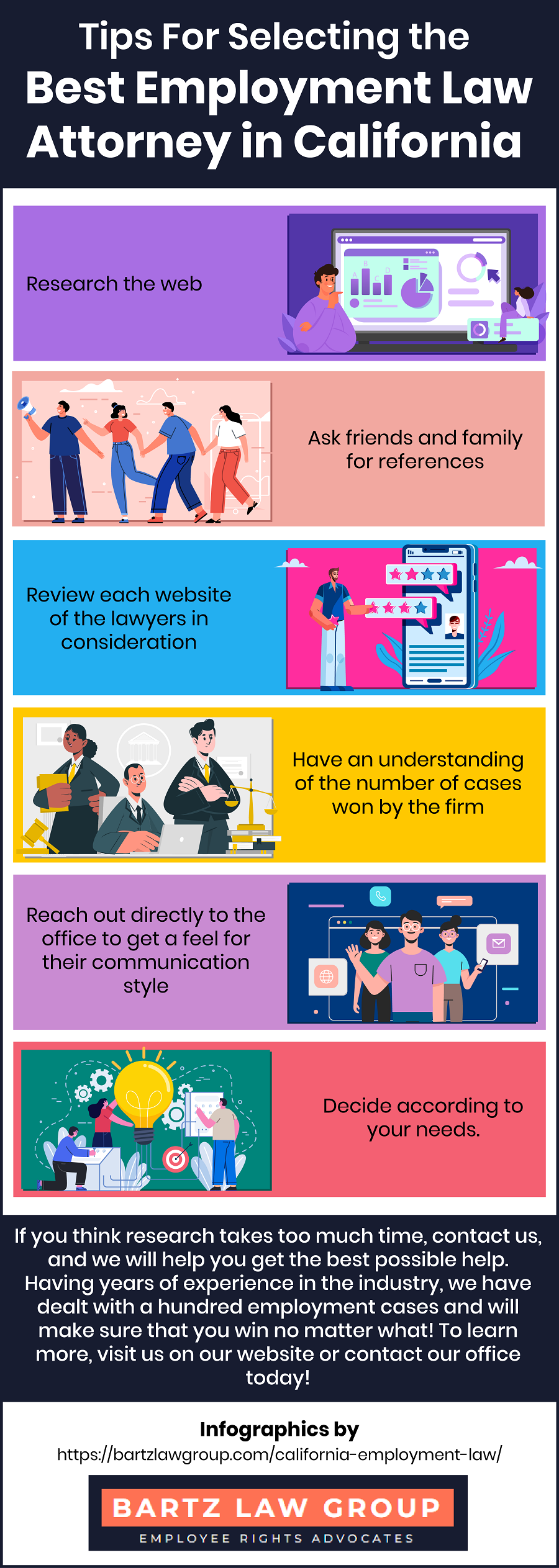
Tips For Selecting the Best Employment Law Attorney in California,
If you are unaware of the employee laws in California and feel that something is off at work lately, we recommend you hire an employment law attorney today! If you cannot decide whom to hire, this infographic is here for your help. So, without wasting any more time, let’s start reading.
California Law on Negligent Hiring, Supervision, and Retention,

According to California law, an employee is responsible for an employee’s negligence, carelessness, or willful misconduct if the company knew or should have known that the person posed a danger to others. This legal doctrine is “negligent hiring, managing, or keeping an employee.”
Contrary to California’s Respondeat Superior statute, which holds employers vicariously responsible for an employee’s wrongdoing, the state’s negligent hiring, supervision, or retention legislation holds employers accountable directly for failing to take reasonable precautions to ensure the safety of others.
This is significant because workers often lack the resources necessary to retain an employment attorney in Southern California and cover all compensatory damages incurred by affected parties. Employers often have more financial resources and are more likely to have insurance to cover their workers’ conduct in a personal injury lawsuit.
Examples of frequent negligent hiring, negligent supervision, or negligent retention situations include:
- A driver with a history of violence is hired by a taxi or ride-sharing firm, and the driver assaults a passenger.
- A restaurant that does not require servers to wash their hands after using the lavatory, a nursing facility in Southern California that does not follow the proper evacuation procedures.
- A patient who suffers a severe injury in a fall may file a lawsuit against the restaurant for food poisoning injuries.
Additionally, businesses that hire untrained nannies, caretakers, camp counselors, daycare workers, babysitters, or youth group leaders regularly face claims of negligent supervision of children.
The Elements of Negligent Hiring, Supervision, or Retention Claims
In California, the plaintiff must show the following to establish that the defendant was negligent in selecting, managing, or retaining an employee:
- The worker was not qualified to perform the duties for which they were recruited.
- The employee’s unfitness or incompetence and the potential danger it posed to others’ safety were both known to or should have been known to the defendant.
- The employee’s unfitness or incompetence harmed the plaintiff.
Who is Considered an Employee in Southern California?
Employees are defined as anybody who is directly under the authority of an employer for California’s negligent hiring, retention, or supervision legislation. These individuals include both paid workers and:
- Temporary employees
- Individual contractors
- Brokers
- Security guards
What is Knowledge About an Employee Required?
An employer must have known or been made aware that the employee was unsuitable or incapable of executing the task they were employed or retained to be held accountable for negligent hiring, supervising, or retention.
Sometimes, all that needs to happen is for the employer to have received notice. In other situations, responsibility is based on the plaintiff’s legal need to exercise reasonable care.
Special Duties of Teachers, Ride-Sharing Companies, and Others
California laws require certain categories of employers to provide in addition to their general duty of care. For instance, schools have a responsibility to take reasonable precautions to safeguard pupils against harm from third parties that is reasonably foreseeable, including carelessness on their part and that of other students, professors, and staff members at the institution.
Companies that operate transportation networks, such as taxis and limousines, are required by law to research the criminal histories of their drivers. A driver with a history of certain offenses, especially violent ones, may not be hired.
Retaining an employment attorney during employee hiring is vital. The hiring process involves many elements that could land you in trouble if overlooked. Your attorney could build a strong defense if you are charged with negligent hiring.
5 Employee Classification Types and How They Compare,

California workers should be classified according to the provisions of employment laws in California and the Fair Labor Standards Act (FLSA). In other words, these two laws should determine employee benefits.
I’m sure you’ve heard the terms “full-time” and “part-time” employees, which are common types of employment contacts. However, there are more types of employment contracts and they are all governed by employment laws in California.
Common Types of Employee Classification
The following are some of the employee classifications you will encounter while applying for a job.
1. Full-time Employees
Full-time employees should work for a minimum of hours in a week or month, and they are paid a salary that remains constant. To be classified as a full-time employee, you must work a minimum of 8 hours a week or 40 hours a month. Additionally, such employees also get other benefits, such as healthcare coverage, 401(k), and employment leaves that accrue over time.
2. Part-time Employees
Part-time employees typically work less than 30 hours per week, and they’re paid on an hourly basis. In most cases, part-time employees decide the number of hours they work and that’s why they’re able to work two or more jobs. Part-time employees can gain experience in multiple fields because the nature of their work allows them to work in different industries.
Examples of industries that hire part-time employees include retail, food service, sales associates, warehouses, and others. Part-time employees are typically classified as “non-exempt” and should receive all the benefits recommended by the FLSA.
3. Contract Employees
Contract employees are usually hired to meet the production targets of a company. The terms of their contacts can vary by industry and job. Working hours for contract employees are not limited to 40 hours a week. One advantage of contract employees is that they can renew or the fact that you fail to renew the contacts as they wish. Contract jobs are ideal for sales, IT professionals, and construction employees. Contract employees are considered nonexempt and qualify for FLSA benefits.
4. Independent Contractors
Independent contractors typically work as contract employees but do not appear on a company’s payroll. The flexibility of working as an independent contractor comes with the freedom of building a unique schedule and completing projects at a reasonable pace.
This employment arrangement is ideal for freelancers, rideshare drivers, and food delivery employees. Independent contractors are employees of the company they work for, meaning they do not receive FLSA and company benefits.
5. Temporary Employees
Temporary employees are also called short-term workers because they’re hired on a short-term basis. These types of workers are mostly hired to cover full-time employees who are absent for some time. Temporary work is ideal for people looking for extra work but for short periods.
These jobs are ideal for retail workers, administrators, housekeepers, and more. Temporary employees are considered non-exempt employees because they earn less than $35,568 annually and they receive hourly pay.
Your employment contract falls into the above-discussed categories. That said, you should seek the help of an employment attorney to help you know your employment status.
5 Questions to Ask Before Filing Legal Action Against Your Employer,

Sometimes you’ll be so annoyed with your employer that bringing legal action would be your only way out. According to this California employment law attorney, there’s a right and wrong when employees are considering filing legal action against their employers.
First, lawsuits are not always the best way to resolve disputes, particularly when the employer is involved. That doesn’t mean that you shouldn’t sue your employer when all other dispute resolution mechanisms have failed and that’s where the services of a California employment law attorney come in.
Questions to Ask Yourself Before Filing Legal action against your Employer
1. Are You Sure the Employer Violated the Law?
Being unfair to employees is not always illegal as much as that statement sounds unfair. Favoritism, poor communication, and other habits are often considered unfair by employees. However, there’s no violation of law in such instances and that’s why you should consider whether the employer violated the law in any way.
2. Have Other Workers been Treated the Same Way?
What you consider mistreatment, or a violation may not be so. With that in mind, it’s always important to find out how other workers are treated and start from there. Although the facts of your situation may differ from other employees, you should first try to establish whether you have a valid ground for filing legal action against your employer.
3. Any backup or Evidence?
Do you have sufficient evidence to prove that you were mistreated or treated unfairly, unjustly, or unlawfully? For instance, can anyone substantiate your claim? Will your supervisor defend you or is everybody siding with the boss? If you lack sufficient evidence to prove your claim, you’re likely to lose the case
4) Are you Still Working for the Employer?
The truth is that it won’t end well if you’re still working for someone you want to sue. Why? They’re likely to retaliate and frustrate you looking for a chance to terminate our contract. Also, how will you feel working in a toxic environment?
Your colleagues will likely be looking at you funny and your supervisor may start picking on you. If you can’t put up with constant stress, the best way forward would be to resign and find another job instead of filing legal action against your current employer.
5) Have you tried Speaking to your Employer?
Have you addressed the situation with the management if you feel harassed, discriminated against, or retaliated against? You should talk to the management, particularly your supervisor before considering legal action.
If your supervisor/ manager doesn’t help, take the case to the HR department and if there’s no HR department in your company, schedule a meeting with the boss. Many employment issues can be resolved without going to court. The good thing about solving an issue internally is that you’ll continue working peacefully if the alleged mistreatment or violation was a misunderstanding.
When filing legal action against an employer it’s wise to consider the repercussions. That said, the questions discussed in this article can help you make informed decisions.
Labor Code 132a & How to Fight Back Against Retaliation,

California’s Labor Code 132(a) forbids employers from retaliating against employees who have filed or intend to file for workers’ compensation payments. Employers who do this, risk criminal prosecution for a misdemeanor offense under state law.
Compensatory damages, such as lost income, back pay, attorney expenses, and potential reinstatement, may also be granted to injured workers.
Workers’ compensation discrimination claim
Under Labor Code 132(a), when you file a discrimination claim in workers’ compensation you must prove that:
- You fired, threatened to fire, or discriminated against an employee due to the injury or workers’ compensation claim.
- You are singled out for unfair treatment due to the injury or claim.
- You filed or intended to file a compensation claim, or because you received a rating, award, or won a compensation case.
Meaning of workers’ compensation discrimination
Any treatment form that disadvantages you could be deemed discrimination. This typically entails firing an employee without cause or threatening to do so. However, it might also consist of:
- Reducing the employee’s hours worked, their wage, or hourly rate.
- Scheduling the employee for a period when their employer is aware that they will be unavailable.
- Reporting you to immigration officers for particular violations.
- Constructive dismissal.
- Ending an employment agreement.
- Denying your benefits.
- Inciting other workers to discipline the employee.
Discrimination need not always be carried out by the employer. For instance, even if an employee is never terminated by the employer, making threats against them may still constitute unlawful discrimination.
Damages You Could Receive After a 132(a) Claim
Specific damages are provided for under California employment law. If you experience discrimination, you could be entitled to:
- Up to $10,000 in additional remuneration.
- $250 in costs and expenses.
- Compensation for lost wages and benefits.
- Job reinstatement.
Serious and Willful Misconduct
If an employer willfully acts or does not act, knowing that a substantial injury would probably ensue, that employer has engaged in serious and willful misconduct. An employer could know the serious safety risks in its production but decide not to address them.
Workers’ compensation payouts for injured employees may be enhanced by up to 50% where the employer engaged in serious and intentional misconduct. However, the overall award cannot be greater than what you could have been entitled to in a conventional civil action.
Filing a California Labor Code 132(a) Case
The California Workers’ Compensation Appeals Board handles complaints of workplace discrimination (WCAB). By filing a claim with the WCAB, you could demand reimbursement, reinstatement, or increased pay. From the date when the discrimination happened or dismissal, you have one year to file a lawsuit.
The WCAB processes requests for reimbursement, reinstatement, and higher remuneration. The WCAB cannot, however, decide whether the criminal complaint against your employer is genuine. The Division of Labor Standards Enforcement may receive a complaint regarding the criminal violation from the appeals board, office of the public prosecutor, or you.
Contact an employment attorney if you want to file a workers’ compensation discrimination case or want to know if your rights have been violated.
Tips For Choosing the Best Employment Law Attorney in California,
It can be challenging to function in an office environment when an employer or employee takes a matter to court. Often, you will be under pressure to make a number of judgments in these situations, and a qualified employment law attorney in California can be crucial in assisting you in handling these matters with objectivity. Here is an infographic on how to find and work with an employment lawyer. These pointers will make sure you receive the finest representation available.
