Whistleblowing under California Employment Laws,

Employees who report workplace misconduct are protected by California whistleblowing law. According to one of the best whistleblower attorneys, these laws specifically protect employees’ retaliation for exposing misdeeds in the workplace.
Whistleblowing is likened to “blowing the whistle” because it involves exposing or reporting workplace misconduct committed by either the employer or other workers. Unfortunately, whistleblowing can jeopardize your job and that’s why it’s important to consult the best whistleblower attorney before making any move.
California’s Whistleblower Law?
California’s whistleblower law protects employees who report law violations and non-compliance with local, state, or federal regulations. The whistleblower law further protects California employees from retaliation in the following instances:
- Refusing to engage in violation of the law, and/or
- Exposing the company’s, colleagues’, or employer’s misdeeds to the relevant authorities.
Firing a worker for whistleblowing is considered wrongful termination in California. The law states that “workers should be free to report “waste, fraud, abuse of authority” and “threat to public health” without any fear of retribution”.
Can Whistleblowers Remain Anonymous?
Yes, a whistleblower can remain anonymous as a whistleblower. However, that’s not always the case because most cases eventually become public. Even if you remain unknown to the public, the organization you are exposing is likely to find out your identity. The organization will undoubtedly try to defend itself against claims that they are doing or has done something wrong. The more serious the wrongdoing, the more likely will the organization be compelled to defend itself.
Reasonable Cause of Wrongdoing
A whistleblower does not have to prove beyond “a shadow of a doubt,” that an organization or their employer is violating a law, rule, or regulation to qualify for protection under California’s whistleblower law. In other words, reasonable cause is not to prove the existence of illegal conduct or wrongdoing. Even if the alleged misconduct is not considered unlawful, filing a claim in good faith based on reasonable belief is sufficient ground to warrant protection under California’s whistleblower law.
Filing a Whistleblower Lawsuit in California
It I,s important to seek the advice of a competent California whistleblower attorney before moving forward and becoming a whistleblower. A whistleblower attorney can evaluate your situation, recommend the available legal options, and help you understand your options in the event of a fallout with your employer. Also, it’s important to consult a legal professional specializing in whistleblowing if you’re already dealing with retaliation from your employer. The lawyer can help you discuss your options before filing a retaliation lawsuit.
Remedies under the Whistleblower Law
Employers are required to reinstate employees and ensure they get their employment and work benefits, lost wages, and compensation for pain and suffering or emotional distress if they file and win a whistleblower retaliation claim. Although whistleblower verdicts can be extensive, most judges frown upon companies that retaliate or punish whistleblowers for being exposed.
California’s whistleblower law is broad and covers a lot. That said, it is advisable to consult a legal professional who specializes in whistleblowing if you want to become a whistleblower.
How a Class Action Lawsuit Works,

A class-action lawsuit is filed by plaintiffs with a similar claim against a common defendant. In personal injury law, a class action is a legal action filed by a group of people with similar claims against one party, usually a corporation, company, or other entity. Bartz Law Group can help you file a class action.
A class action is a classic example of parties pulling together because the individuals involved bring their resources and mind together for a common cause. However, class actions are not the typical lawsuit. That said, the services or advice of a legal firm, such as Bartz Law Group can be invaluable when filing a class action.
In addition, creative solutions can come out of a class action settlement, especially in non-injury cases. For example, several department stores agreed to give away free makeup for a limited time to settle a class action that alleged the stores secretly worked together to keep cosmetic prices artificially high.
Filing a Class Action Lawsuit
A complaint is a court document for initiating legal action. When completing the required documentation, filing a class action involves checking the appropriate box in a complaint sheet in court. The complaint contains the allegations leveled against the defendant and that is why the process is sometimes called serving a complaint on the defendant.
Once a class action complaint is served on the defendant, the certification of the class and the requirements for certification can vary by state. However, most states have the same requirements. That said, the representative plaintiff must prove the following facts to qualify for certification:
- The class representative suffered the same injuries as the other members of the class;
- The class members can be distinctly identified;
- The class is composed of a certain minimum––21 is usually the minimum;
- The individual grievances are related to a common question of law;
- The class representative must prove that they can represent all members adequately; and
- A class action is the most efficient way of resolving the case.
That said, getting a class certification is not just checking the right boxes. Further, the judge is allowed to exercise discretion, meaning the arguments for or against certification can get quite complex and protracted.
Failing to be certified means the case (class action) will be dismissed and on the other hand, the case moves to the pre-trial stage if the class is certified. Also, being certified does not mean that the defendant is guilty of the claims brought by the class, or that a court will likely find the defendant liable/guilty. Additionally, certification does not mean the case has advanced to some extent, and the defendant is now facing a legitimate lawsuit. That said, injury settlement negotiations begin after the class has been certified.
Class actions involve many plaintiffs and one defendant. For the best outcome, it’s always advisable to involve a legal professional who specializes in class actions.
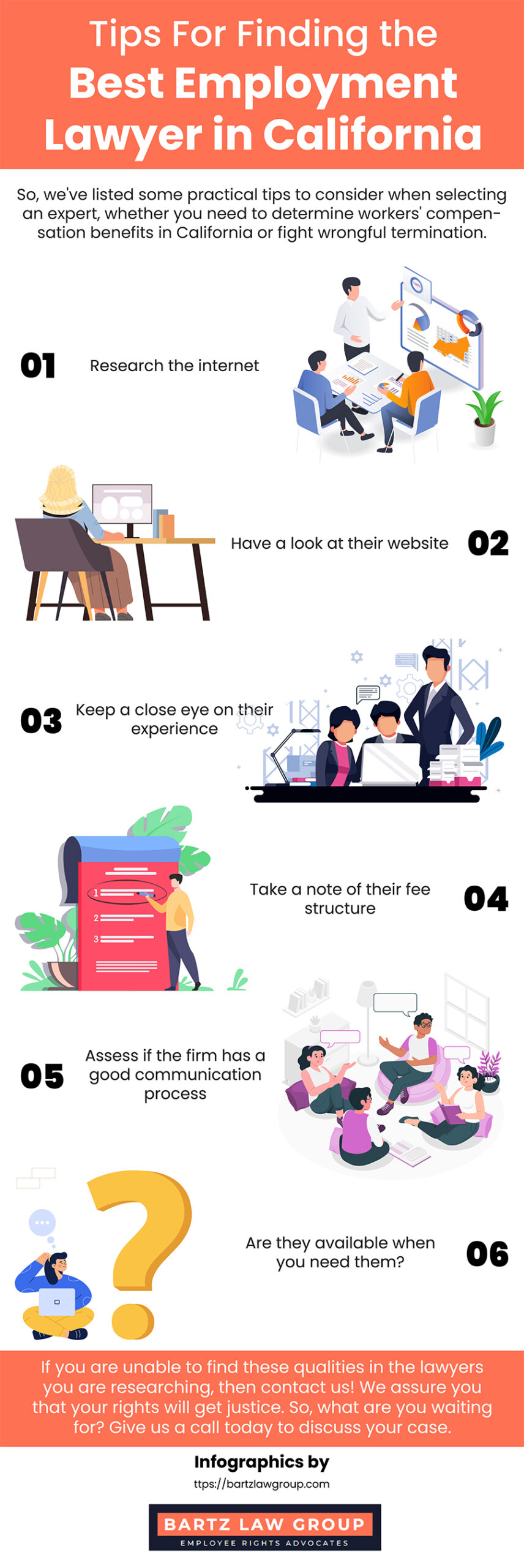
Tips for Finding the Best Employment Lawyer in California,
For most professionals, several situations may arise that necessitate the expert advice and representation of an employment lawyer, ranging from unfair job loss to workplace bullying. Given the prevalence of workplace hostility and wrongful termination cases, it’s important to know when to consult a California employment lawyer to save your job. While wrongful termination, workplace discrimination, unfair wages, and whistleblowing are valid reasons to consult an employment lawyer, it is also critical to find a specialist in this area of the law.
Grounds for Wrongful Termination in California,

California employers can fire at-will employees with or without a reason. However, firing an employee for unlawful reasons is considered wrongful termination. Should this situation happen, the unlawfully terminated employee can search online for a lawyer to sue the employer. Wrongful termination can leave you confused, particularly if you don’t have another source of income.
You will likely be wondering if you have a claim, where to start, and more. The good news is that you have the solution at your fingertips. Using your phone, one can search for a “lawyer to sue my employer” online. You may be asking, when can you sue your employer for wrongful termination?
Grounds for Wrongful Termination in California
1. Termination Based on Protected Aspects
California employees are protected from harassment and discrimination at the workplace by the Fair Employment and Housing Act. The provisions of the two Acts also prohibit retaliation against workers for:
- Opposing harassment and discrimination;
- Whistleblowing; or
- Testifying against the company or employer.
Workplace discrimination occurs when an employee is unfairly targeted due to their:
- Race;
- Skin completion or tone;
- Sexual orientation;
- Gender and age;
- Religious affiliation, and more.
An employee can sue the employer if the decision to fire them was based on a protected characteristic.
2. Termination for Whistleblowing
Whistleblower terminations typically occur when an employee reports a law violation or malpractice at the workplace to a government agency or enforcement agency. In California, the Labor Code 1102.5 LC provides whistleblowers’ protection. Under this law, employers are prohibited from retaliating against whistleblowers (an employee who reports law violations and malpractices at the workplace).
3. Termination Related to Implied Contracts
An implied employment contract is neither in writing nor verbal. Instead, such contracts are based on statements or actions of the employer that imply or suggest that an employee cannot be terminated without good cause (a legally sufficient reason). An implied contract can occur in the following ways:
- Issuing the employee a handbook that specifies when they can be fired; or
- Guaranteeing an employee’s job safety to an employee provided they don’t violate certain rules or laws.
4. Termination for Refusing to Violate a Public Policy
Sometimes employers order employees to break the law for their selfish interests. For instance, when an employer wants to commit financial fraud, they may coerce the accountant to cook figures. If the accountant is terminated for refusing to cooperate, they can file a wrongful termination claim for failing to violate a public policy.
5. Termination for Filing an Injury Claim
Having an active workers’ compensation policy is a mandatory legal requirement for California employers. Additionally, employees are entitled to compensation for workplace-related injuries–meaning they can file a claim for injuries sustained in the course of working.
If an employee is fired for reporting a work-related injury or filing for workers’ compensation, they have grounds for bringing a wrongful termination claim against their former employer.
California employers can terminate the services of their employees with or without any reason. However, most importantly a termination should not violate the provisions of the Fair Employment and Housing Acts.
Exceptions to California’s At-Will Employment Rule,

The “at-will” employment rule states that employers can terminate the services of employees at any time, for any reason or none. According to a California employment attorney, California’s Labor Code presumes that all employment contracts are “at-will” except when an employment contract states otherwise, or when an exception to the rule (at-will) applies.
The exceptions to the at-will employment rule allow wrongfully terminated employees to sue their employers as specified under California wrongful termination laws. Not many people can have the courage to sue their employers for wrongful termination and that’s where the assistance of a California employment lawyer comes in. The lawyer will assess your case to establish whether or not you have a claim before recommending an appropriate solution.
What are the Exceptions to the At-Will Employment Rule?
The exceptions to the at-will employment rule in California are:
- Implied contract;
- The implied covenant of good faith and fair dealings;
- Public policy; and
1. The Implied Contract Exception
Under this exception, an employer cannot terminate an employee if an implied contract between an employer and employee exists even if there’s no written instrument to prove that relationship. Consequently, it’s hard to prove the existence of an implied contract and the onus of proof is on the terminated employee.
Implied contracts are presumed to exist if a company’s or employer’s policies state that a worker cannot be discharged except for good cause or if a company has rules that govern employee termination. Discharging an employee whose terms of engagement are based on an implied employment contract is considered a breach of contract.
2. The Implied Covenant of Good Faith Exception
The implied covenant of good faith and fair dealing is an implied and binding understanding that the parties to an employment contract (employer and employee) will transact honestly, fairly and in good faith. This covenant aims to stabilize the power imbalance that typically exists between employees and employers.
3. The “Public Policy” Exception
The public policy exception states that an employer cannot discharge an employee if a discharge would contravene the doctrine of public policy. But what is the meaning of public policy in the employment context? The public policy exception bars an employer from firing employees in disregard of the labor statutes of the state. For instance, an employee should not be discharged for filing a compensation claim for work-related injuries. Firing an employee in disregard of the public policy exception is considered wrongful termination. Employees can sue their employers for wrongful termination if they were fired because of:
- Refusing to violate a certain law,
- Performing their legal obligations;
- Exercising their legal rights; or
- Whistleblowing.
To sustain a wrongful termination claim under the public policy exception, the discharged employee must prove the following facts:
- The policy or law that they refused to violate is legally defined in law, a constitutional provision, or an ethical rule;
- The policy should be beneficial to the public;
- The policy should be fundamental and substantial; and
Constructive Termination
This occurs when the working conditions become unbearable and an employee is left with no option but to resign. Sometimes an employer can make the working conditions intolerable to force employees to quit/resign. In such cases, the ex-employees can sue their former employer.
Although employers can discharge employees at any time and for any reason, or none, the exceptions to California’s at-will rule allow employees to sue their employers for terminating their services without good course.
Prohibited Unfair Practices under Employment Law,

The employee rights California labor law prohibits discriminating against employees based on their race, gender, religion, age, sexual orientation, and others. Also, retaliation or revenge against employees for airing their grievances is prohibited. Besides discrimination and retaliation, other unfair employment practices in employment exist.
Unfair employment practices refer to any act that contravenes or violates Employee rights California labor law, Equal Employment Opportunities Commission, California’s Employment Code. Unfair labor practices apply to all aspects of employment and the best way to protect yourself as an employee is to know your rights as specified under Californian Labor Statutes.
Employment Discrimination
Discrimination in the workplace is prohibited by federal and state laws. Federal and state governments have enacted several statutes since the enactment of the Civil Rights Act of 1964. Those statutes protect employment discrimination based on:
- Age and gender;
- Sexual orientation;
- Race, skin color, and place of origin;
- Disability and physical appearance, and more.
3 Labor Practices Considered Illegal in California
Employee rights California labor law protects both prospective and existing employees against unfair employment policies. In this article, we’ll cover several unfair employment practices, including:
- Job Advertisements
Job advertisements should be open to everyone as long as an applicant possess the stated minimum qualifications. In other words, companies are prohibited from publishing job advertisements that discriminate against a prospective job applicant based on race, religious affiliation, disability, and more. For instance, an employer should not turn down an applicant based on their physical disability. Instead, adjustments should be done to meet the needs of applicants with special needs. - Job Assignments & Promotions
Employers are prohibited from assigning duties and giving promotions based on the protected aspects of employment, such as color, religion, gender, and others. For instance, lighter duties should be shared by all employees, regardless of their race. Favoring some workers over others is considered discrimination and unfair employment practice. - Pay and Benefits
According to the Equal Employment Opportunities Commission, California employees are entitled to fair wages and other benefits that should be awarded for their positions. Otherwise, discrimination based on the protected employment aspects is considered unethical employment practices. Discriminated employees can file legal action against the employer or file a claim with the relevant authority. - Discipline & Contract Termination
Employers should punish disobedient workers based on their race, skin color, creed, age, and more. For instance, an employer should not give different punishments for a similar offense committed by two employees of different races. When discharging many or several employees, employers are forbidden from basing their decision on age. - Training & Apprenticeship Programs
Training or apprenticeship programs should not be discriminative toward employees on the bases of their identity. For instance, an employer should not deny training opportunities to certain races, particularly the minorities, such as African-Americans, Indians, and others. However, the law sometimes allows employers to set an age limit as a minimum qualification.
Any act that violates the employee rights of California labor law is considered unfair labor practice in California. A legal professional specializing in employment law can help you understand this topic in detail.
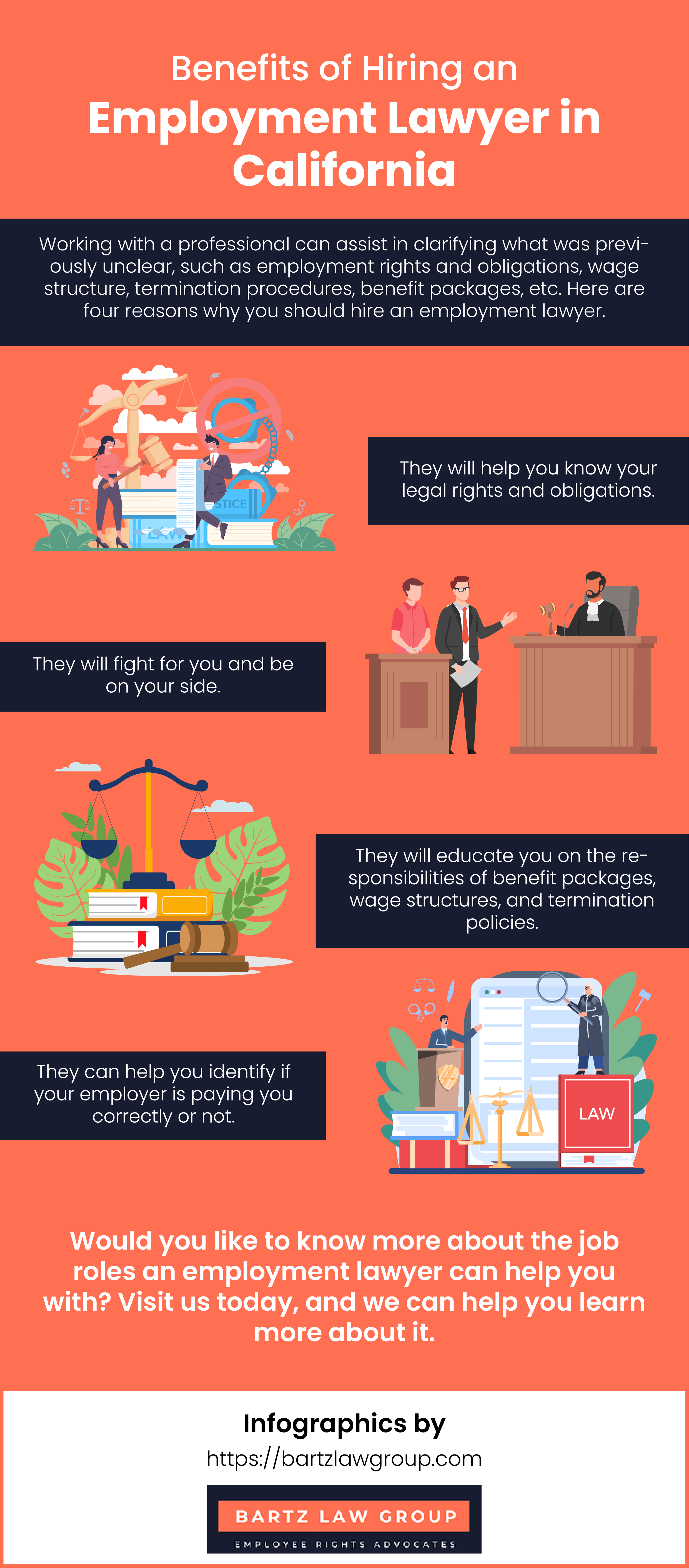
Benefits of Hiring an Employment Lawyer in California,
A lot of times your rights as an employee are being violated and you have no idea that it is happening. Understanding your rights and obligations as an employee can be complicated. That is why there are employment lawyers Southern California.
California Laws on Employer Use of Arrest and Conviction Records,

In California, criminal records could lock ex-convicts out of certain job opportunities and be denied housing in specific neighborhoods. Your potential employer could screen your criminal background or ask for your criminal history during your job application.
However, California employment law regulates the use of arrest and conviction records. The statutes include:
California Ban-the-Box Law
In 2018, California passed the Ban-the-Box law under the amended Fair Employment and Housing Act (FEHA). Under the statute, public and private employers with more than five workers cannot ask about your criminal history until they offer you employment.
Also, the employers should evaluate your qualifications before secluding you because of your criminal history. Should the employer decide not to hire you based on your criminal record, they must notify you in writing and allow you to explain the circumstances.
However, there are some exceptions to this rule. For example, if you will be working in a law enforcement agency, with children, the elderly, or the disabled, your employer could ask about your criminal history on a job application.
The Link Between the Ban-The-Box Law and Antidiscrimination Laws
California and federal laws prohibit employers from discriminating against potential employees based on characteristics like race or ethnicity. Disqualifying applicants because they have criminal history could appear like racial discrimination. For instance, Latinos and African Americans face more arrests than other ethnicities in California.
The Equal Employment Opportunity Commission Guidelines
The Equal Employment Opportunity Commission (EEOC) regulates how employers handle job applicants with criminal records. Employers must avoid discriminating against applicants even when disqualifying them. The guidelines require that employers ask applicants with criminal pasts to explain their offenses’ circumstances. The mandates ensure convicted applicants who pose no significant risks to the employer undergo fair hiring processes.
Fair Employment and Housing Act Guidelines
On 1st July 2017, FEHA provided guidelines on how employers could prevent discrimination cases when assessing applicants with criminal pasts. Guidelines that FEHA set are like Ban-the-Box laws. These guidelines illegalize:
- Rejecting job applicants based on their criminal records.
- Discriminating against job applicants based on their ethnicity.
If the applicant has a criminal history, the employer must prove that they disqualified the applicant based on job-related causes and not because of criminal history.
Labor Codes
- Labor Code Section 432.7. The statute illegalized employers’ acts of requesting an applicant’s arrest history that never resulted in a conviction, even if they reached pre-trial or post-trial programs.
- Labor Code Section 432.8. Under this statute, employers cannot ask ex-convictions about their marijuana convictions over two years old, sealed, statutorily deleted, or expunged convictions.
- Labor Code Section 432.8. The law prohibits employers from asking for your criminal record if you are not applying for sensitive positions, such as working with children, the elderly, or the disabled.
Background Check Guidelines
Employers could conduct background checks using third parties or in-house. If the employer considers hiring a third party, they must obey the Fair Credit Reporting Act (FCRA) regulations. The employer must provide notices and ask for the applicant’s written consent before conducting checks.
The notices are:
- Opportunity to respond. The employer must send you a written notice explaining the exact conviction resulting in disqualification. The convictions must not be over seven years. You could respond with an explanation stating inaccuracies or mitigating factors.
- Notice of final decision. The employer should consider your explanation. If the employer disqualifies the applicant completely, they must issue the applicant a written notice.
You have the right to file a complaint with the Department of Fair Employment and Housing (DFEH). If you win the case, the accused employer is liable for damages you suffer for facing discrimination, including attorney fees, court expenses, and your compensation.
Drug and Alcohol Testing and Employments Pt. 2,

As a job applicant you ensure that you adhere to all necessary requirements in order for you to increase your chances of being employed. This may include subjecting yourself to psychometric tests, medical tests, etc. However, in some instances an employer may make it a requirement for job applicants to take drug tests as part of the final stage of the selection process. This article will discuss the job applicant’s decision in respect of such a test and the job applicant’s legal rights.
The previous article discussed some of the reasons employers may administer drug tests to potential job applicants. Further, it noted that because of the intrusive nature of drug testing there are laws that limit when a drug test may be carried out, the way the drug test may be carried out and whether it can be carried out. As with most workplace circumstances, current employees have more rights in the area of drug testing as compared to job applicants as a refusal to take a drug test may mean they lose the chance of getting the job. If you feel that your rights as an employee have been violated, follow the link lawyer to sue my employer for legal advice and representation.
The reality is that a prospective employer cannot force a potential employee to take a drug test. However, it is within their legal right to make it a general requirement or condition of employment; only if they follow the rules. If you personally feel that you do not want to take a drug test you can mention this and take yourself out of the race for the job.
Take note of the legal limitations that are applicable with regards to applicant drug testing:
- Disability discrimination claims – applicants that take medication for a disability are protected from discrimination by way of the provision of the Americans with Disabilities Act. There are some prescribed medications that may turn up on a drug test. Further, some drugs that are known to be illegal, such as opiates, may be legally prescribed by medical doctors for specific medical conditions. Therefore, in the event that a job applicant is rejected on the basis of a positive drug test for medication that they are legally prescribed in respect of a disability then the company can be held liable for damages.
- Other claims of discrimination – where a company chooses to single out specific groups of applicants based on, for example, their race or disability, for drug testing it is likely that the company will face claims for discrimination. If testing is a necessity the employer may focus on specific job classifications where testing is a requirement, for example, job positions that are safety-sensitive. However, the employer would then test all job applicants for that specific job classification or position.
- Violation of required state procedures – in as much as all states allow job applicant drug testing, most states have in place procedural and other requirements that must be adhered to. For example, in some states drug testing is only allowed after the applicant has been given an offer of employment based on passing the drug test.
- Applicant privacy must not be violated to conduct the test.
Drug and Alcohol Testing and Employments Pt. 1,

As a job applicant you ensure that you adhere to all necessary requirements for you to increase your chances of being employed. This may include subjecting yourself to psychometric tests, medical tests, etc. However, in some instances an employer may make it a requirement for job applicants to take drug tests as part of the final stage of the selection process. This article and a subsequent one will discuss the reason for drug testing in order to obtain employment, the job applicant’s decision in respect of such a test and the job applicant’s legal rights.
It must be noted that the majority of private employers do not make it a requirement to conduct drug or alcohol tests as part of the selection process. That being said, in respect of specific job positions and industries such testing is a requirement. This includes the transportation industry as well as safety sensitive industries. Often these industries are regulated by specific federal agencies, for example, the Federal Highway Administration, Federal Aviation Administration as well as the U. S. Coast Guard. As such, it is a requirement for drug and alcohol testing in the trucking industry, aviation industry, contracts linked to the Department of Defense or mass transit. If you feel your employee rights have been violated as a result, seek out legal advice and representation with employment law firms California [https://bartzlawgroup.com].
Some of the reasons why employers make drug or alcohol testing a requirement include the following:
- Qualification for worker’s compensation discounts [How To Maximize The Discounts On Your Workers Compensation Insurance (roguerisk.com)] – a lot of states make offers to employers in respect of a discount on their worker’s compensation insurance premiums. Such discounts are applicable only if the employer takes specific steps in ensuring and maintaining a drug-free workplace; and this may include having job applicants tested.
- Avoidance of legal liability – when an injury or harm occurs on the job as a result of an intoxicated employee, the employer may find themselves legally liable for the injuries sustained. Further, the use of drugs and alcohol in the workplace may violate occupational safety and health state laws.
- Productivity and money-saving – it must be noted that drug and alcohol abuse annually cost businesses, because of low productivity, up to $80 billion. Employees that use drugs are 3-5 times more likely to be late for work, involved in workplace accidents and file for worker’s compensation claims as compared to those who do not use drugs.
While the above reasons may justify drug testing in the workplace the question then is how legal is drug testing in the workplace? It is important to note that drug testing has a direct implication on privacy rights. Such form of testing does not look at current drug use but also shows past use including drugs taken on the employee’s own time. Further, the test may not necessarily exclude the use of legal drugs. In order to administer some tests, it may require that bodily fluids be surrendered under close supervision. As a result of the intrusive nature of drug testing there are federal and state laws that limit the when, how and if such testing can be done. Current employees have more rights than job applicants in this regard.