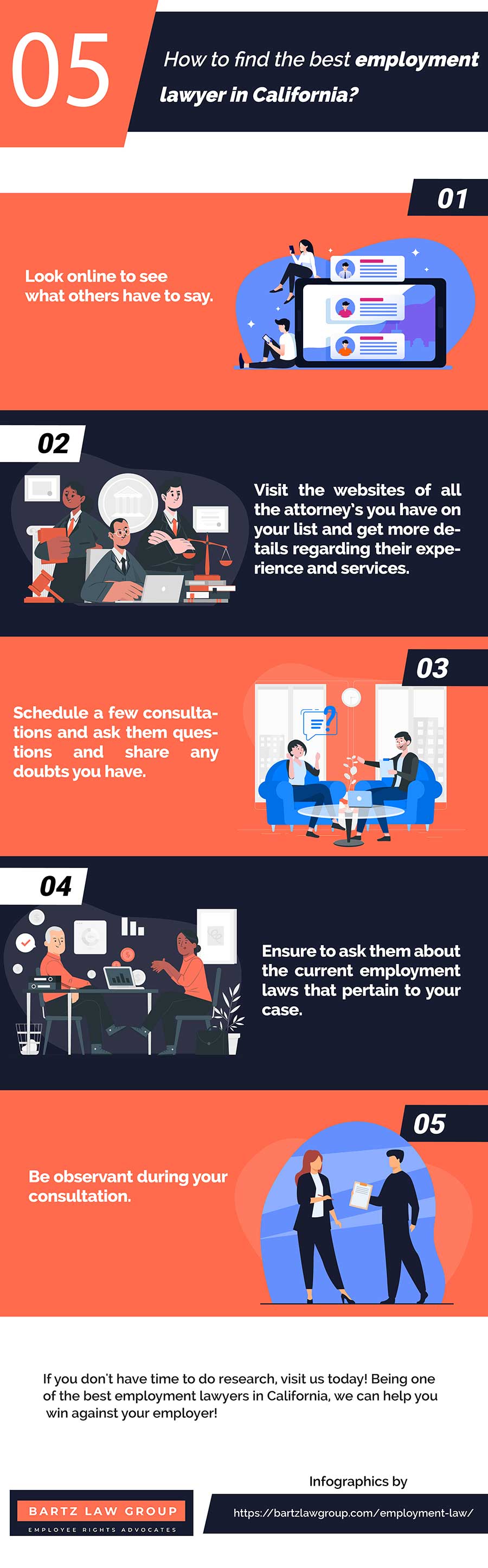
How to find the best employment lawyer in California?,
If you feel that you have been a victim of any illegal act by your employer, it’s time that you put you find an employment lawyer to help you fight for your legal rights. You might think that it’s just a waste of time as you can never win against the big company you work for, but the top employment lawyers in California can help you! All you need to do is find the right one for fighting your case. So, let’s have a look at this infographic which provides you with a few tips on how to find the top employment lawyers in california for your case.
The Immigration Reform and Control Act and I-9 Audit,

The right to employment for individuals who are qualified for a job is preserved in the Immigration Reform and Control Act (IRCA), and it’s implemented by the Immigration and Naturalization Service. Understanding the provisions of the IRCA can be tricky for a layman but top employment law firms in California can help.
All Americans have a right to be employed as long as they qualify for a vacant position. Employers are prohibited from hiring (for a fee) job applicants who are not permitted to work in the U.S. The law was implemented to fight illegal immigration. You should consult top employment law firms in California to legally protect yourself as an employer.
I-9 Audit and Strategic Compliance
Americans have a right to employment as per the IRCA but employers must verify their employees’ eligibility for employment. Employee verification is provided for in Section 274a.2 of the Immigration and Nationality Act (INA) requiring such verifications to be done using Form I-9.
Employing unauthorized employees is an employment violation and is considered a prosecutable crime with serious penalties. The Immigration and Customs Enforcement ensures that all employers abide by the provisions of the IRCA and the INA by either issuing notices of inspection to employers or conducting impromptu I-9 audits.
Mistakes or deficiencies identified by I-9 audits must be rectified within 10 business days before the ICE issues a clean bill of health. The following points can help employers develop a strong strategy to avoid the negative consequences of violating the provisions of the IRCA and the INA:
1. Seek Legal Counsel
You should hire an attorney after receiving a notice of inspection because an unfavorable I-9 audit can attract severe penalties, such as criminal prosecution and business sanctions, particularly if you knowingly violated the law.
An employment attorney can help you stay compliant by completing the I-9 forms and other relevant documents. Your attorney will also provide legal advice on the consequences of non-compliance with the IRCA and the INA and how it impacts your business.
2. Learn the Triggers of I-9 Audits
The triggers for I-9 audits can include:
- Complaints from former or current employees;
- Mistreated job seekers’ tipoffs;
- Negative reviews of past I-9 data;
- Employees’ tipoff’s; and
- Routine I-9 audits by the government;
It’s important to understand the trigger for your I-9 audit and the extent of the violation to develop an appropriate response to address noncompliance.
3. Evidence Possessed by the ICE
Employers and their legal teams should strive to know the information possessed by the ICE to develop a strong defense strategy. Also, you can work on the non-compliance immediately if you know why the notice of inspection was issued.
4. Avoid Criminal Prosecution at All Costs
The immediate goal should be avoiding a criminal charge and a subsequent prosecution if you’re guilty of non-complying with the IRCA or ICA. Your legal team should develop a strategy to help you avoid prosecution after considering the facts of your case, including the triggers of the NOI, the focus area of the audit, and the available remedies.
Employers should be proactive to ensure they comply with the provisions of the ICRA and the ICA in maintaining I-9 data.
Coping with Job Loss,

Losing a job can disrupt your financial stability and throw you into a panic. Should this happen, you’ll some how need to find a way of paying your bills, health insurance, and debts. Fortunately, you can contact an employment attorney in southern California if you’re facing a job loss.
Many resources or solutions can help alleviate the challenges of job losses. Free consultation from an employment attorney in southern California will leave you informed, ready to adapt to job loss, and in a better position to reinvent yourself.
Job Loss and Severance Pay
Jobs are not permanent and that’s why you should be always prepared, whether you anticipate being laid off or not. One typically has 21 days to sign when offered a dismissal agreement, so you should not feel pressured. Once that agreement has been signed, you have 7 days in case you change your mind. Now quitting your job may appear to be a good option when faced with a likely layoff, but staying the course and not quitting in such times entitles you to different benefits, such as:
1. Severance Pay
Severance pay is the compensation given to employees who are laid off due to redundancy, or parting ways with their employers. This pay should be commensurate with one to two weeks’ earnings per year, although it could be more. You should discuss the challenges likely to be caused by the layoff with your employer.
High-ranking employees, such as managers or executives typically receive higher severance packages, and the severance pay can be for more than a period of a year. The Consolidated Omnibus Budget Reconciliation Act (COBRA) requires companies with 20 or more employees to continue paying health insurance to laid-off employees for a certain duration, usually 18 months. Alternatively, unemployment insurance should be the other option.
2. Unemployment Insurance Policy
Try to extend your health, life, and disability insurance coverage. The provisions of the Consolidated Omnibus Budget Reconciliation Act allow the laid-off employees to continue being provided with a disability, life, and health coverage for 18 months or longer in some cases.
This policy can be costly since the employee pays both their premiums as well as the employer’s share. Fortunately, the government waived premiums for laid-off employees and those workers with lesser work hours under the American Rescue Plan Act of 2021. You should establish whether your company pays for the health insurance for the laid-off employees until they’re able to find employment. You can also ask if life insurance and disability income insurance are provided during that period.
3. Outplacement
Outplacement is a service for helping outgoing employees to find new jobs and simplify the transition process. Outplacement services are offered by some employers and it’s beneficial in many ways, such as financially, careerwise, and emotionally. Additionally, the service facilitates a smooth transition–promoting peace of mind.
Laid-off employees can negotiate other benefits besides the ones discussed in this article, including pension plans, company perks, stocks, special considerations, and others.
The Right to Privacy in the Workplace,

Technology simplifies work, promoting efficiency– although it can also be used to infringe the rights of others in a workplace environment. For instance, the right to privacy is violated by many employers because they can monitor their employees virtually thanks to technology. Workers in California should have a basic knowledge of California employment law to protect themselves against a variety of issues including privacy.
While monitoring employees is legal according to California employment law, some employers exceed their boundaries and violate the privacy rights of employees. Among other issues, surveillance aimed at monitoring personal items in restricted areas, such as locked cabinets is illegal. The following are some common issues related to employee privacy in the workplace.
Internet Usage and Email
Most alleged personal privacy violations occur when employees use company assests, such as a computer, to access the internet, send personal emails, or for other uses. Did you know that an employer has the right to monitor their workers’ emails when company assets are being used?
Monitoring can include evaluating an employee’s performance, blocking malware, or fighting cybercrime.
Employers can also track internet traffic through work computers, WiFi, or via the company’s internet service provider. This right extends to monitoring employees’ online activities by opening the visited websites, blocking some websites, or limiting internet browsing time.
Using the internet incorrectly is considered employee misconduct in some companies and it can be used as leverage in workplace discrimination and wrongful terminations.
Phone Calls and Voicemail Messages
Employers use surveillance to monitor their workers’ phone conversations, SMS, and voicemail messages to establish the loyalty and commitment of such workers toward the business. An employer can monitor an employee’s phone usage but with certain boundaries. According to the Electronic Communications Privacy Act (ECPA), employers are prohibited from monitoring personal calls, SMS, and voicemail. In other words, it’s illegal to monitor your workers’ phone usage. The terms and requirements of ECPA are also applicable to workers’ phone usage at the workplace.
Employers can only monitor workers’ phone usage with the employee’s consent but is illegal to monitor if the employee is unaware. In addition, employees can bring a claim against an employer for accessing, listening, reading, sharing, deleting, or denying access to your voicemail.
Drug Testing before Hiring
Employers have the right to request drug testing on prospective employees, although some jurisdictions have rules for demanding and performing a drug test. Drug testing is limited to:
- Individuals who have risky duties, such as machine operators;
- Workers with a history of drugs crimes;
- Workers who have been involved in a work-related accident where drug use was suspected
- Workers who show physical signs of drugs abuse, such as red eyes, slurred speech, and others.
The right to privacy in the workplace is often violated by some employers when they overstep the boundaries. On the other hand, some “alleged violations” are within the provisions of the Electronic Communications Privacy Act (ECPA). An employment attorney or expert can offer more advice on this subject.